Showing posts with label Black Hole. Show all posts

Wednesday, September 8, 2010

Black Hole Mass Related to Globular Cluster Numbers


A photo of the jet emitted by the black hole in galaxy M87

The mass a supermassive black hole at the center of a large galaxy has appears to be related to the number of globular cluster that particular galaxy contains, a new report suggests.

The data has been derived from a new investigation of the stars, which indicates that the two are somehow linked. The exact mechanisms underlying this connection are still unclear.

There are many such correlations in astronomy, experts say, even if some are arguably clearer than others. Given that the new connection was observed in several cases, scientists will continue to analyze it until they get to the bottom of it.

One interesting aspect of the new discovery is that it holds more value for some galaxies than for others. Astronomers say that finding out precisely why this happens is yet another mystery that needs solving.

In past studies, astrophysicists demonstrated that supermassive black holes exert numerous influences on their host galaxies, including regulating their growth.

In addition, these SMBH can also influence the total amount of dark matter massive galaxies contain, change the brightness of the bulges spiral galaxies have, and influence the masses of these bulges.

But astronomers also know that the luminosity of a galaxy and the amount of dark matter its halo contains are also influenced by the number of globular clusters the cosmic structure contains.

Researchers wanted to learn whether they could eliminate the intermediaries, and still maintain a direct correlation, between the SMBH and the number of clusters.

According to team leaders Andreas Burkert of the Max Planck Institute for Extraterrestrial Physics, in Germany, and Scott Tremaine, at the Princeton University, this is entirely possible.

The discovery hints at a previously-unknown regulation mechanism. It was confirmed in 13 different instances, the research team says.

Details of the investigation will be published in an upcoming issue of the esteemed scientific journal Monthly Notices of the Royal Astronomical Society.

The journal entry also features a follow-up on the original study, which includes case studies of 33 galaxies. Even with these increased number of instances, the correlation holds true.

Interestingly, it was found that the connection is especially true for elliptical galaxies. For lenticular galaxies, the team failed to uncover any correlation.

No reasons as to why that happens have yet been discovered, Universe Today reports.

Tuesday, April 27, 2010

Explanation: Supermassive Black Hole Formation


Image comment: This illustration of the black hole in Andromeda shows an old lopsided stellar disk (red) orbiting a black hole (black dot)
Image credits: NASA / ESA / A. Field


One of the greatest mysteries in the fields of astronomy and astrophysics was until recently figuring out how supermassive black holes get so big. These impressively-large formations can be found at the cores of equally-massive galaxies, and they can grow continuously until their reach masses a billion times larger than that of the Sun. For many years, various explanations have been proposed and dismissed, but now a new idea appears to hold up to thorough scientific scrutiny.

It's a widely-known fact that black holes grow by accumulating mass from their surroundings. They attract various materials, such as cosmic gas and dust, in their surroundings, and then make them a part of their accretion disks. These are the circular structures that can be found around most large black holes, from which the dark behemoth continuously draws matter. But, in the case of gas being gobbled up by these structures, astrophysicists ran into a dilemma, PhysOrg reports.

The gas has a large angular momentum, which means that it basically moves too fast to allow for the black holes to trap it into their accretion disks. So experts have been pondering on the mechanisms the formations employ in slowing the gas down sufficiently. University of California in Berkeley (UCB) astrophysicists Philip Hopkins and Eliot Quataert recently published a new study, in which they propose that old lopsided stellar disks, such as the one noticed around the black hole at the core our neighboring galaxy, Andromeda, may play a pivotal part in slowing down the swirling gas.

These disks can grow to a diameter of dozens of light-years, and, due to their lopsided nature, they tend to exert an uneven gravitational attraction on the incoming gas. This in turn causes various gas filaments within the larger clouds to collide with each other, creating friction, and reducing speed sufficiently to allow for the black hole that traps the gas with its own gravitational pull. In spite of popular belief, the dark behemoths can only gobble up gas if it passes within one light-year of their event horizon. Through this mechanism, the investigators propose, a black hole such as Andromeda's could gain several solar mass-worth of matter each year, helping to account for its current mass.

Tuesday, April 6, 2010

Cold Atoms and Nanotubes Come Together in an Atomic 'Black Hole'


Carbon nanotubes, long touted for applications in materials and electronics, may also be the stuff of atomic-scale black holes.

Physicists at Harvard University have found that a high-voltage nanotube can cause cold atoms to spiral inward under dramatic acceleration before disintegrating violently. Their experiments, the first to demonstrate something akin to a black hole at atomic scale, are described in the current issue of the journal Physical Review Letters.

"On a scale of nanometers, we create an inexorable and destructive pull similar to what black holes exert on matter at cosmic scales," says Lene Vestergaard Hau, Mallinckrodt Professor of Physics and of Applied Physics at Harvard. "As importantly for scientists, this is the first merging of cold-atom and nanoscale science, and it opens the door to a new generation of cold atom experiments and nanoscale devices."

Hau and co-authors Anne Goodsell, Trygve Ristroph, and Jene A. Golovchenko laser-cooled clouds of one million rubidium atoms to just a fraction of a degree above absolute zero. The physicists then launched this millimeter-long atomic cloud towards a suspended carbon nanotube, located some two centimeters away and charged to hundreds of volts.

The vast majority of the atoms passed right by the wire, but those that came within a micron of it -- roughly 10 atoms in every million-atom cloud -- were inescapably attracted, reaching high speeds as they spiraled toward the nanotube.

"From a start at about 5 meters per second, the cold atoms reach speeds of roughly 1,200 meters per second, or more than 2,700 miles per hour, as they circle the nanotube," says Goodsell, a graduate student on the project and now a postdoctoral researcher in physics at Harvard. "As part of this tremendous acceleration, the temperature corresponding to the atoms' kinetic energy increases from 0.1 degrees Kelvin to thousands of degrees Kelvin in less than a microsecond."

At this point, the speeding atoms separate into an electron and an ion rotating in parallel around the nanowire, completing each orbit in just a few trillionths of a second. The electron eventually gets sucked into the nanotube via quantum tunneling, causing its companion ion to shoot away -- repelled by the strong charge of the 300-volt nanotube -- at a speed of roughly 26 kilometers per second, or 59,000 miles per hour.

The entire experiment was conducted with great precision, allowing the scientists unprecedented access to both cold-atom and nanoscale processes.

"Cold-atom and nanoscale science have each provided exciting new systems for study and applications," says Golovchenko, Rumford Professor of Physics and Gordon McKay Professor of Applied Physics at Harvard. "This is the first experimental realization of a combined cold atom-nanostructure system. Our system demonstrates sensitive probing of atom, electron, and ion dynamics at the nanoscale."

The single-walled carbon nanotube used in these researchers' successful experiment was dubbed "Lucy," and its contributions are acknowledged in the Physical Review Letterspaper. The nanotube was grown by chemical vapor deposition across a 10-micron gap in a silicon chip that provides the nanowire with both mechanical support and electrical contact.

"From the atom's point of view, the nanotube is infinitely long and thin, creating a singular effect on the atom," Hau says.

This work was supported by the Air Force Office of Scientific Research and the National Science Foundation.

Goodsell et al. Field Ionization of Cold Atoms near the Wall of a Single Carbon Nanotube. Physical Review Letters, 2010; 104 (13): 133002 DOI:10.1103/PhysRevLett.104.133002

Source: ScienceDaily

Friday, March 26, 2010

After growth spurt, supermassive black holes spend half their lives veiled in dust


Supermassive black holes found at the centers of distant galaxies undergo huge growth spurts as a result of galactic collisions, according to a new study by astronomers at Yale University and the University of Hawaii. Their findings appear in the March 25 edition of Science Express. As massive, gas-rich galaxies in the distant universe collide, the central black hole feeds on gas that is funneled to the center of the merger. "As a result of the violent, messy collision, the black hole also remains obscured behind a 'veil' of dust for between 10 million and 100 million years," said Priyamvada Natarajan, professor of astronomy at Yale and one of the paper's authors. After that time the dust is blown away to reveal a brightly shining quasar—the central region of a galaxy with an extremely energetic, supermassive black hole at its center—that lasts for another 100 million years, the team found.

Until now, astronomers were unsure how long the quasars spent behind the dust cloud. While unobscured quasars, which are the brightest optical objects in the early universe, were discovered in the late 1950s, examples of quasars obscured by dust were more difficult to detect, and were only discovered in the late 1990s. "For many years, astronomers believed that these sources were very rare. Now we are seeing them everywhere," said Ezequiel Treister of the University of Hawaii, lead author of the study.

The team used observations from the Hubble, Chandra and Spitzer space telescopes to identify a large number of obscured, dust-enshrouded quasars up to 11 billion light years away, when the universe was only about one-fifth its current age. "We detected a signature of very hot dust at infrared and X-ray wavelengths to find these obscured sources," Treister said.

"Once they had been identified, we used Hubble's new Wide Field Camera 3—which astronauts installed last year during the final servicing mission—to confirm that these distant quasars were actually the result of mergers," said Kevin Schawinski, another Yale co-author.

The researchers discovered that the number of obscured quasars relative to the unobscured ones was significantly larger in the early universe than it is now, giving them a new understanding of how these objects formed and evolved over time. "We knew from theoretical models that mergers of massive, gas-rich galaxies were more frequent in the past," said Natarajan, the theorist of the team. "Now we've found that these mergers are responsible for producing both the nearby obscured quasar population and their distant cousins."

The astronomers coupled the telescope observations with estimated galaxy merger rates and theoretical models to come up with the amount of time it takes for the black hole to blow away the surrounding dust and gas and reveal the naked, bright quasar. "We found that these growing black holes spend about half their lives veiled in dust, and half their lives unveiled," Natarajan said. "That means that, until now, we have likely been missing half of the actively growing black holes in the early universe."

Major galaxy mergers are important triggers for star formation as well as modifying galaxy shape and structure. "This work confirms that mergers are also critical for the growth and evolution of central giant black holes, which continue to feed and gain weight during both the hidden phase and when they shine freely," Natarajan said.

Source: Yale University

Tuesday, March 23, 2010

How Dark Matter Behaves Around Black Holes


The standard explanation of how our Universe is set up states that roughly one quarter (23 percent) of everything is made out of dark matter, a form of matter that cannot be readily observed through conventional means. In fact, it has never been observed at all, although scientists tried out a wide variety of methods for detecting it. But now, two experts advance a new role for dark matter that proposes the stuff altered the amounts of galaxies in the Universe, and that it did so to a significant margin, AlphaGalileo reports.

Astronomers Dr Xavier Hernandez and Dr William Lee, both of whom are based at the National Autonomous University of Mexico (UNAM), say that their study was prompted by their curiosity in learning how dark matter would interact with the supermassive black holes that form at the cores of impressively-large galaxies. The team says that its models provided them with a new basis for calculating both these interactions and the rate at which dark matter would get sucked in through the event horizon.

The group determined the existence of a threshold in these rates. If the immediate surroundings of the black hole are laden with dark matter in amounts higher than 7 Sun masses per cubic light-year, then the initial black hole was found to be capable of growing at extremely fast rates. Their investigation also revealed that, if such a growth spur was activated, then the black hole would be fueled even further by dark matter, eventually consuming the galaxy around it. If the galaxy would survive this ordeal, the group says, then it would be altered beyond any possible recognition when compared to its original shape.

“Over the billions of years since galaxies formed, such runaway absorption of dark matter in black holes would have altered the population of galaxies away from what we actually observe,” Hernandez says. The greatest implication of their analysis is the fact that the amounts of dark matter present at the cores of galaxies needs must tend for a constant value, if the entire structure is to remain stable. An additional implication is that dark matter may be behaving in ways previously not thought-of. This means that current models aimed at explaining its behavior – and which therefore underline efforts to find the stuff – may have to be thought over.

Wednesday, March 17, 2010

Spitzer unearths primitive black-holes


These two data plots from Spitzer show a primitive supermassive black hole (top) compared to a typical one. As the data show, the typical supermassive black hole, called J0842+1218, exhibits the signs of a surrounding ring of dust, a feature that appears at longer wavelengths of infrared light. The primitive object, called J0005-0006, lacks a dusty torus.

These Spitzer data, along with other observations not shown here, led to the discovery of the two most primitive supermassive black holes known, J0005-0006 and J0303-0019. Both objects are about 13 billion light-years away.

Usually, a supermassive black hole is surrounded by an accretion disk, which itself is surrounded by a dark doughnut-like dusty structure called a dust torus. But for the primitive black holes, the dust tori are missing and only gas disks are observed. This is because the early universe was clean as a whistle. Enough time had not passed for molecules to clump together into dust particles. Some black holes forming during this era thus started out lacking dust. As they grew, gobbling up more and more mass, they are thought to have accumulated dusty rings.

Credit: NASA/JPL-Caltech/University of Arizona


Astronomers have come across what appear to be two of the earliest and most primitive supermassive black holes known.

The discovery, based largely on observations from NASA's Spitzer Space Telescope, will provide a better understanding of the roots of our universe, and how the very first black holes, galaxies and stars came to be.

"We have found what are likely first-generation quasars, born in a dust-free medium and at the earliest stages of evolution," said Linhua Jiang of the University of Arizona, Tucson. Jiang is the lead author of a paper announcing the findings in the March 18 issue of Nature.

Black holes are beastly distortions of space and time. The most massive and active ones lurk at the cores of galaxies, and are usually surrounded by doughnut-shaped structures of dust and gas that feed and sustain the growing black holes. These hungry, supermassive black holes are called quasars.

As grimy and unkempt as our present-day universe is today, scientists believe the very early universe didn't have any dust -- which tells them that the most primitive quasars should also be dust-free. But nobody had seen such immaculate quasars -- until now. Spitzer has identified two -- the smallest on record -- about 13 billion light-years away from Earth.

The quasars, called J0005-0006 and J0303-0019, were first unveiled in visible light using data from the Sloan Digital Sky Survey. That discovery team, which included Jiang, was led by Xiaohui Fan, a coauthor of the recent paper at the University of Arizona. NASA's Chandra X-ray Observatory had also observed X-rays from one of the objects. X-rays, ultraviolet and optical light stream out from quasars as the gas surrounding them is swallowed.

"Quasars emit an enormous amount of light, making them detectable literally at the edge of the observable universe," said Fan.

When Jiang and his colleagues set out to observe J0005-0006 and J0303-0019 with Spitzer between 2006 and 2009, their targets didn't stand out much from the usual quasar bunch. Spitzer measured infrared light from the objects along with 19 others, all belonging to a class of the most distant quasars known. Each quasar is anchored by a supermassive black hole weighing more than 100 million suns.

Of the 21 quasars, J0005-0006 and J0303-0019 lacked characteristic signatures of hot dust, the Spitzer data showed. Spitzer's infrared sight makes the space telescope ideally suited to detect the warm glow of dust that has been heated by feeding black holes.

"We think these early black holes are forming around the time when the dust was first forming in the universe, less than one billion years after the Big Bang," said Fan. "The primordial universe did not contain any molecules that could coagulate to form dust. The elements necessary for this process were produced and pumped into the universe later by stars."

The astronomers also observed that the amount of hot dust in a quasar goes up with the mass of its black hole. As a black hole grows, dust has more time to materialize around it. The black holes at the cores of J0005-0006 and J0303-0019 have the smallest measured masses known in the early universe, indicating they are particularly young, and at a stage when dust has not yet formed around them.

Other authors include W.N. Brandt of Pennsylvania State University, University Park; Chris L. Carilli of the National Radio Astronomy Observatory, Socorro, N.M.; Eiichi Egami of the University of Arizona; Dean C. Hines of the Space Science Institute, Boulder, Colo.; Jaron D. Kurk of the Max Planck Institute for Extraterrestrial Physics, Germany; Gordon T. Richards of Drexel University, Philadephia, Pa.; Yue Shen of the Harvard Smithsonian Center for Astrophysics, Cambridge, Mass.; Michael A. Strauss of Princeton, N.J.; Marianne Vestergaard of the University of Arizona and Niels Bohr Institute in Denmark; and Fabian Walter of the Max Planck Institute for Astronomy, Germany. Fan and Kurk were based in part at the Max Planck Institute for Astronomy when this research was conducted.

The Spitzer observations were made before the telescope ran out of its liquid coolant in May 2009, beginning its "warm" mission.

Thursday, July 2, 2009

VLBA locates superenergetic bursts near giant black hole


Using a worldwide combination of diverse telescopes, astronomers have discovered that a giant galaxy's bursts of very high energy gamma rays are coming from a region very close to the supermassive black hole at its core. The discovery provides important new information about the mysterious workings of the powerful "engines" in the centers of innumerable galaxies throughout the Universe. The galaxy M87, 50 million light-years from Earth, harbors at its center a black hole more than six billion times more massive than the Sun. Black holes are concentrations of matter so dense that not even light can escape their gravitational pull. The black hole is believed to draw material from its surroundings -- material that, as it falls toward the black hole, forms a tightly-rotating disk.

Processes near this "accretion disk," powered by the immense gravitational energy of the black hole, propel energetic material outward for thousands of light-years. This produces the "jets" seen emerging from many galaxies. In 1998, astronomers found that M87 also was emitting flares of gamma rays a trillion times more energetic than visible light.

However, the telescopes that discovered these bursts of very high energy gamma rays could not determine exactly where in the galaxy they originated. In 2007 and 2008, the astronomers using these gamma-ray telescopes combined forces with a team using the National Science Foundation's continent-wide Very Long Baseline Array (VLBA), a radio telescope with extremely high resolving power, or ability to see fine detail.

"Combining the gamma-ray observations with the supersharp radio 'vision' of the VLBA allowed us to see that the gamma rays are coming from a region very near the black hole itself," said Craig Walker, of the National Radio Astronomy Observatory (NRAO).

"Pinning down this location addresses what was an open question and provides important clues for understanding how such highly energetic emissions are produced in the jets of active galaxies," said Matthias Beilicke, of Washington University in St. Louis, MO.

The gamma-ray flares from the galaxy were monitored by systems of large telescopes designed to detect faint flashes of blue light that result when gamma rays enter the Earth's atmosphere. Data from sensitive cameras in these systems can allow astronomers to infer the energy of the gamma rays and the direction from which they came. Their directional information, however, is not precise enough to narrow down the gamma-ray-emitting region within the galaxy.

The VLBA offered a millionfold improvement in resolving power, allowing the scientists to determine that the gamma rays are coming from the immediate vicinity of the black hole. Though gamma rays are the most energetic form of electromagnetic radiation and radio waves the least energetic, both often arise from the same regions. This was shown clearly when M87's most energetic gamma-ray flares were accompanied by the largest flare of radio waves seen from that galaxy by the VLBA.

The radio flare began at about the time of the gamma-ray flares, but continued to increase in brightness for at least two months. "This tells us that energetic material burst out very close to the black hole, causing the gamma rays to be emitted and the radio flare to begin. As that material traveled down the jet, expanding and losing energy, the gamma-ray emission ceased, but the radio continued to increase in brightness," Walker explained. "The VLBA showed us with great precision where the radio emission came from, so we know the gamma rays came from closer in toward the black hole," he added.

M87 is the largest galaxy in the Virgo Cluster of galaxies, at the center of a supercluster of galaxies that includes the Local Group, of which our own Milky Way is a member. The black hole in M87 has an "event horizon," from which matter cannot escape, roughly twice the size of our Solar System, or a tiny fraction of the size of the entire galaxy. The new measurements indicate that the gamma rays are coming from an area no larger than 50 times the size of the event horizon.

The telescope systems that detected the gamma-ray flares are the VERITAS array in Arizona, the H.E.S.S. system in Namibia, Africa, and the MAGIC system on La Palma in the Canary Islands.

Source: National Radio Astronomy Observatory

XMM-Newton discovers a new class of black holes


Illustration of HLX-1 (blue star to the upper left hand side of the galactic bulge). HLX-1, located on the outskirts of the spiral galaxy ESO 243-49, is the strongest candidate to- date of intermediate-mass black holes. Credits: Heidi Sagerud

Astronomers using ESA’s XMM-Newton X-ray observatory have discovered a black hole weighing more than 500 solar masses, a missing link between lighter stellar-mass and heavier supermassive black holes, in a distant galaxy. This discovery is the best detection to date of a new class that has long been searched for: intermediate mass black holes.

Due to appear tomorrow in the journal Nature, the discovery has been made by an international team of researchers working with XMM-Newton data, led by Sean Farrell from the Centre d’Etude Spatiale des Rayonnements, now based at the University of Leicester.

Stellar-mass black holes (about three to twenty times as massive as the Sun) and supermassive black holes (several million to several thousand million times as massive as the Sun) have long been known to exist. Because of the large gap between these two extremes, scientists have speculated the existence of a third, intermediate class of black holes, with masses between a hundred and several hundred thousand solar masses.

Up until now, scientists were unable to confirm that this elusive intermediate class actually existed.


Farrell’s team were analysing archived data obtained by XMM-Newton, looking for neutron stars and white dwarves, when they stumbled upon a most peculiar object that was observed on 23 November 2004.

Called HLX-1 (Hyper-Luminous X-ray source 1), it lies towards the outskirts of the galaxy ESO 243-49, approximately 290 million light-years from Earth. If it is indeed located in this distant galaxy, HLX-1 is very luminous in X-rays; peaking at 260 million times the luminosity of the Sun.

On analysing the light originating from HLX-1, the team found that the X-ray signature was inconsistent with any object other than a feeding black hole. The measured brightness was too low for it to be in our own Galaxy, and the lack of observed radio or optical emission from the location of HLX-1 in addition to the observed X-ray signature indicates that it is unlikely to be a background galaxy.

This means that the source of the X-ray emission must lie in ESO 243-49. Its location is too far away from the galactic centre for it to be a supermassive black hole, and too bright for a stellar-mass black hole feeding at the maximum rate.

To be sure that this really was a single astronomical object, and not a cluster of several fainter sources that was shining brightly, the team used XMM-Newton to observe it again on 28 November 2008.

Comparing the two observations, they found that the signature of X-rays originating from HLX-1 varied significantly in time and concluded from this that it must be a single object. They found that the only way to explain its intense luminosity was if HLX-1 harboured a black hole greater than 500 solar masses. No other physical explanation could account for what they had seen.


The few intermediate-mass black hole candidates that have been discovered so far could be accounted for by other theories, but this one stood out as it was brighter than all the previous candidates by a factor of almost 10. The team had their hands on the best detection of an intermediate mass black holes to-date.

While it is already known that stellar-mass black holes are the remnants of massive stars, how supermassive black holes form is still unknown. One of the possible scenarios involves mergers of intermediate mass black holes. To ratify such a theory, it is essential to prove their existence in the first place.


This is why detections such as this by XMM-Newton are essential. It will help to understand just how supermassive black holes, such as that at the centre of our Galaxy, form.

The team have planned further observations in X-ray, ultraviolet, optical, infrared and radio wavelengths in the near future to better understand this unique object and the environment around it.

Thursday, June 18, 2009

Visitors will gravitate to Black Holes exhibit


On Sunday, June 21, a new exhibit developed by educators and scientists at the Harvard-Smithsonian Center for Astrophysics (CfA) will open at the Boston Museum of Science.

Called “Black Holes: Space Warps & Time Twists,” the traveling exhibition pulls visitors into the modern search for real black holes – the most mysterious and powerful objects in the universe.

Black holes are regions in space with gravity so powerful that nothing can escape, and where time and space are warped beyond our understanding. The exhibition will guide visitors on a journey to the edge of these strange objects to discover how the latest research is turning science fiction into fact, challenging our notions of space and time in the process.

"In this exhibition, we wanted to use the inherent fascination of black holes as a compelling vehicle to engage museum visitors in the larger story of how scientific discovery works - and how science is connected to human curiosity, imagination, and culture," said project director Mary Dussault of the CfA.

CfA personnel spent two and a half years planning, designing and constructing the 2,500-square-foot exhibition. Its interactive stations address a number of questions, such as:

• What is a black hole?

• Where are black holes?

• How do we find black holes if they are really black?

• What would happen if you fell into a black hole?

One feature sure to be popular: a station where visitors can experience their own black hole adventure. Using one of three "excursion pods," they will embark on a fantasy "adventure vacation" to the black hole at the center of our galaxy. As they make their way toward this "deep space dive," visitors explore the phenomena around the black hole, including warped space, the slowing of time, and the dangerous magnetic fields and radiation that could leave them stranded on their cosmic adventure.

As they travel through the exhibit, visitors carry their own bar-coded Explorer's Card, which they can use to collect discoveries and to generate a personalized Website that only they can access. Once visitors return home, their journal becomes a personal portal to further black hole exploration and a platform for sharing their “Black Holes” exhibit experience with friends and family.

“Black Holes” was made possible by a generous grant from the National Science Foundation, with additional major support from the National Aeronautics and Space Administration. The exhibition will be on display at the Museum of Science through Sept. 7, 2009, and is included with regular admission.

Wednesday, June 17, 2009

Physicists create 'black hole for sound'


By accelerating atoms across the dark gap at the centre of this image, researchers think they might be able to create an acoustic black hole capable of producing the first detectable Hawking radiation (Image: O. Lahav et al.)

An artificial black hole that traps sound instead of light has been created in an attempt to detect theoretical Hawking radiation. The radiation, proposed by physicist Stephen Hawking more than 30 years ago, causes black holes to evaporate over time.

Astrophysical black holes are created when matter becomes so dense that it collapses to a point called a singularity. The black hole's gravity is so great that nothing – not even light – can escape from a boundary around it called an event horizon.

But physicists have also been developing 'black holes' for sound. They do this by coaxing a material to move faster than the speed of sound in that medium, so that sound waves travelling within it cannot keep up, like fish swimming in a fast-moving stream. The sound is effectively trapped in the stream-like event horizon.

Quantum state

The materials physicists are focusing on are called Bose-Einstein condensates (BECs), a quantum state of matter where a clump of atoms behaves like a single atom.

Condensates have been made that move supersonically before, so physicists have likely created acoustic black holes in the process of working with BECs, says Eric Cornell of the University of Colorado at Boulder, who shared a 2001 Nobel Prize for the development of Bose-Einstein condensates.

But he says a new study by Jeff Steinhauer of the Technion-Israel Institute of Technology in Haifa and colleagues is the first documented experiment directly aimed at producing Hawking radiation in a BEC.

Supersonic flow

The team cooled 100,000 or so charged rubidium atoms to a few billionths of a degree above absolute zero and trapped them with a magnetic field. Using a laser, the researchers then created a well of electric potential that attracted the atoms and caused them to zip across the well faster than the speed of sound in the material.

This setup created a supersonic flow that lasted for some 8 milliseconds, fleetingly forming an acoustic black hole capable of trapping sound.

The implications of such work could be profound, as it could lead to the first detection of Hawking radiation.

Quantum mechanics says that pairs of particles can spontaneously appear out of empty space. These pairs, which consist of a particle and its antiparticle, should exist for a fleeting moment before they annihilate each other and disappear.

But in the 1970s, Hawking proposed that if the pair was created near the edge of a black hole, one particle might fall in before it is destroyed, leaving its partner stranded outside the event horizon. To observers, this particle would appear as radiation. In acoustic black holes, Hawking radiation would take the form of particle-like packets of vibrational energy called phonons.

Big boon

Finding Hawking radiation would be a big boon for physics, says cosmologist Sean Carroll of Caltech. "For one thing, Stephen Hawking would win the Nobel Prize," Carroll told New Scientist. "But it would more just show us that we're on the right track."

That's because Hawking's theory makes some fundamental propositions about how quantum mechanics works in space that is curved by gravity. The underlying math is used to calculate how the universe behaved during a period called inflation, when space rapidly expanded soon after the big bang.

Detecting Hawking radiation through astronomical observations, however, is difficult, because the evaporation of typical black holes is obscured by higher-energy sources of radiation, including the cosmic microwave background, the afterglow of the big bang.

'First step'

And researchers still have a way to go before they can detect Hawking radiation in acoustic black holes. Steinhauer's team, for example, estimates that the boost in velocity that atoms get in their setup must be about 10 times bigger in order to create detectable Hawking radiation in the form of phonons.

"Actually detecting the sound waves produced by the hole is really tough. But this is an exciting first step," says Bill Unruh of the University of British Columbia in Vancouver, Canada, who first proposed the idea of using quantum fluids to create artificial event horizons.

Cornell agrees, adding that the team needs to make the BEC flow much more smoothly in order to measure the subtle sign of Hawking radiation. "What they've done is kind of the easy part," he told New Scientist. "The hard part is to do that in such a quiet way that you can see all the tiny fluctuations on top of all the violent things you've done to the condensate [to make it go supersonic]."

Cornell and his colleagues are building their own experimental setup to produce acoustic event horizons.

Laser pulses

And others hope to produce detectable Hawking radiation in the lab using light. In 2008, a team created an artificial event horizon in an optical fibre, exploiting the fact that different wavelengths of light move at different speeds in the fibre.

They did this by sending a relatively slow-moving pulse down the fibre. This distorted the fibre's optical properties, so that when a second, faster pulse caught up with the first one, it was slowed down and effectively became trapped behind the event-horizon-like leading edge of the first pulse.

An astrophysical detection of Hawking radiation may still be possible. The smaller a black hole is, the higher the energy its Hawking radiation is. So the evaporation of microscopic black holes that some researchers suspect were created almost immediately after the big bang might be detectable using NASA's Fermi Gamma-ray Space Telescope, which launched in 2008.


Source:- NewScientist

Wednesday, June 10, 2009

Texas-Sized Computer Finds Most Massive Black Hole in Galaxy M87


The illustration shows the relationship between the mass of a galaxy’s central black hole and the mass of its central bulge. The new higher mass Gebhardt and Thomas computer modeled for M87’s black hole, 6.4 billion solar masses, could change this relationship. They used a more complete computer model than previous work. This may mean that the black holes in all nearby massive galaxies are more massive than we think, signaling a change in our understanding of the relationship between a black hole and its surrounding galaxy. Credit: Tim Jones/UT-Austin after K. Cordes & S. Brown (STScI)


PASADENA, Calif. — Astronomers Karl Gebhardt (The University of Texas at Austin) and Jens Thomas (Max Planck Institute for Extraterrestrial Physics) have used new computer modeling techniques to discover that the black hole at the heart of M87, one the largest nearby giant galaxies, is two to three times more massive than previously thought. Weighing in at 6.4 billion times the Sun’s mass, it is the most massive black hole yet measured with a robust technique, and suggests that the accepted black hole masses in nearby large galaxies may be off by similar amounts. This has consequences for theories of how galaxies form and grow, and might even solve a long-standing astronomical paradox.

Gebhardt will detail these results in a press conference June 8 at 12 Noon PDT at the 214th meeting of the American Astronomical Society in Pasadena, Calif. They will be published later this summer in The Astrophysical Journal, in a paper by Gebhardt and Thomas.

To try to understand how galaxies form and grow, astronomers need to start with basic census information about today’s galaxies. What are they made of? How big are they? How much do they weigh? Astronomers measure this last category, galaxy mass, by clocking the speed of stars orbiting within the galaxy.

Studies of the total mass are important, Thomas said, but “the crucial point is to determine whether the mass is in the black hole, the stars, or the dark halo. You have to run a sophisticated model to be able to discover which is which. The more components you have, the more complicated the model is.”

To model M87, Gebhardt and Thomas used one of the world’s most powerful supercomputers, the Lonestar system at The University of Texas at Austin’s Texas Advanced Computing Center. Lonestar is a Dell Linux cluster with 5,840 processing cores and can perform 62 trillion floating-point operations per second. (Today’s top-of-the-line laptop computer has two cores and can perform up to 10 billion floating-point operations per second.)

Gebhardt and Jens’ model of M87 was more complicated than previous models of the galaxy, because in addition to modeling its stars and black hole, it takes into account the galaxy’s “dark halo,” a spherical region surrounding a galaxy that extends beyond its main visible structure, containing the galaxy’s mysterious “dark matter.”

“In the past, we have always considered the dark halo to be significant, but we did not have the computing resources to explore it as well,” Gebhardt said. “We were only able to use stars and black holes before. Toss in the dark halo, it becomes too computationally expensive, you have to go to supercomputers.”

The Lonestar result was a mass for M87’s black hole several times what previous models have found. “We did not expect it at all,” Gebhardt said. He and Jens simply wanted to test their model on “the most important galaxy out there,” he said.

Extremely massive and conveniently nearby (in astronomical terms), M87 was one of the first galaxies suggested to harbor a central black hole nearly three decades ago. It also has an active jet shooting light out the galaxy’s core as matter swirls closer to the black hole, allowing astronomers to study the process by which black holes attract matter. All of these factors make M87 the “the anchor for supermassive black hole studies,” Gebhardt said.

These new results for M87, together with hints from other recent studies and his own recent telescope observations (publications in preparation), lead him to suspect that all black hole masses for the most massive galaxies are underestimated.

That conclusion “is important for how black holes relate to galaxies,” Thomas said. “If you change the mass of the black hole, you change how the black hole relates to the galaxy.” There is a tight relation between the galaxy and its black hole which had allowed researchers to probe the physics of how galaxies grow over cosmic time. Increasing the black hole masses in the most massive galaxies will cause this relation to be re-evaluated.

Higher masses for black holes in nearby galaxies also could solve a paradox concerning the masses of quasars — active black holes at the centers of extremely distant galaxies, seen at a much earlier cosmic epoch. Quasars shine brightly as the material spiraling in, giving off copious radiation before crossing the event horizon (the region beyond which nothing — not even light — can escape).

“There is a long-standing problem in that quasar black hole masses were very large — 10 billion solar masses,” Gebhardt said. “But in local galaxies, we never saw black holes that massive, not nearly. The suspicion was before that the quasar masses were wrong,” he said. But “if we increase the mass of M87 two or three times, the problem almost goes away.”

Today’s conclusions are model-based, but Gebhardt also has made new telescope observations of M87 and other galaxies using new powerful instruments on the Gemini North Telescope and the European Southern Observatory’s Very Large Telescope. He said these data, which will be submitted for publication soon, support the current model-based conclusions about black hole mass.

For future telescope observations of galactic dark haloes, Gebhardt notes that a relatively new instrument at The University of Texas at Austin’s McDonald Observatory is perfect. “If you need to study the halo to get the black hole mass, there’s no better instrument than VIRUS-P,” he said. The instrument is a spectrograph. It separates the light from astronomical objects into its component wavelengths, creating a signature that can be read to find out an object’s distance, speed, motion, temperature, and more.

VIRUS-P is good for halo studies because it can take spectra over a very large area of sky, allowing astronomers to reach the very low light levels at large distances from the galaxy center where the dark halo is dominant. It is a prototype, built to test technology going into the larger VIRUS spectrograph for the forthcoming Hobby-Eberly Telescope Dark Energy Experiment (HETDEX).

Thursday, May 28, 2009

Ghost remains after black hole eruption


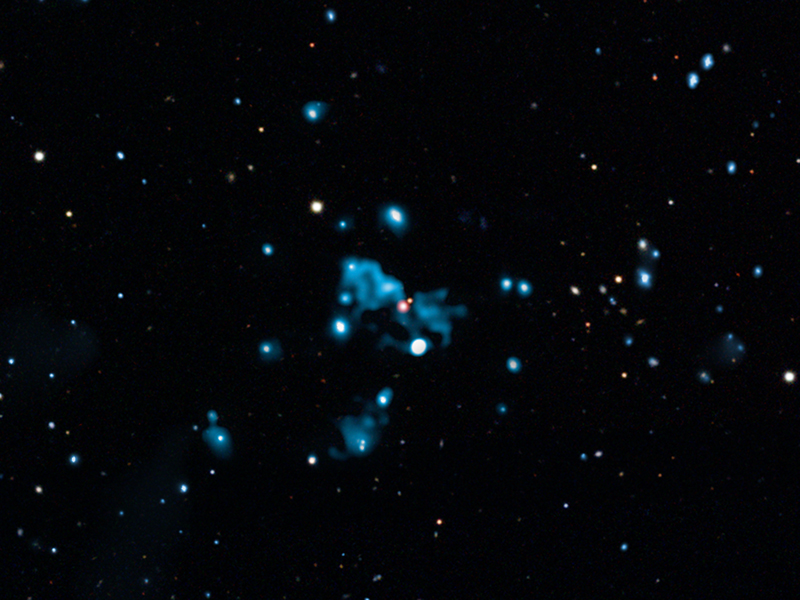
NASA's Chandra X-ray Observatory has found a cosmic "ghost" lurking around a distant supermassive black hole. This is the first detection of such a high-energy apparition, and scientists think it is evidence of a huge eruption produced by the black hole.

This discovery presents astronomers with a valuable opportunity to observe phenomena that occurred when the Universe was very young. The X-ray ghost, so-called because a diffuse X-ray source has remained after other radiation from the outburst has died away, is in the Chandra Deep Field-North, one of the deepest X-ray images ever taken. The source, a.k.a. HDF 130, is over 10 billion light years away and existed at a time 3 billion years after the Big Bang, when galaxies and black holes were forming at a high rate.

"We'd seen this fuzzy object a few years ago, but didn't realize until now that we were seeing a ghost", said Andy Fabian of the Cambridge University in the United Kingdom. "It's not out there to haunt us, rather it's telling us something - in this case what was happening in this galaxy billions of year ago."

Fabian and colleagues think the X-ray glow from HDF 130 is evidence for a powerful outburst from its central black hole in the form of jets of energetic particles traveling at almost the speed of light. When the eruption was ongoing, it produced prodigious amounts of radio and X-radiation, but after several million years, the radio signal faded from view as the electrons radiated away their energy.

However, less energetic electrons can still produce X-rays by interacting with the pervasive sea of photons remaining from the Big Bang – the cosmic background radiation. Collisions between these electrons and the background photons can impart enough energy to the photons to boost them into the X-ray energy band. This process produces an extended X-ray source that lasts for another 30 million years or so.

"This ghost tells us about the black hole's eruption long after it has died," said co-author Scott Chapman, also of Cambridge University. "This means we don't have to catch the black holes in the act to witness the big impact they have."


HDF 130
This is a composite image showing a small region of the Chandra Deep Field North. Shown in blue is a deep image from the Chandra X-ray Observatory and in red is an image from the Multi-Element Radio Linked Interferometer Network (MERLIN) an array of radio telescopes based in Great Britain. An optical image from the Sloan Digital Sky Survey (SDSS) is shown in white, yellow and orange. Credit: X-ray (NASA/CXC/IoA/A.Fabian et al.); Optical (SDSS), Radio (STFC/JBO/MERLIN)


This is the first X-ray ghost ever seen after the demise of radio-bright jets. Astronomers have observed extensive X-ray emission with a similar origin, but only from galaxies with radio emission on large scales, signifying continued eruptions. In HDF 130, only a point source is detected in radio images, coinciding with the massive elliptical galaxy seen in its optical image. This radio source indicates the presence of a growing supermassive black hole.


"This result hints that the X-ray sky should be littered with such ghosts," said co-author Caitlin Casey, also of Cambridge, "especially if black hole eruptions are as common as we think they are in the early Universe."

The power contained in the black hole eruption was likely to be considerable, equivalent to about a billion supernovas. The energy is dumped into the surroundings and transports and heats the gas.

"Even after the ghost disappears, most of the energy from the black hole's eruption remains", said Fabian. "Because they're so powerful, these eruptions can have profound effects lasting for billions of years."

The details of Chandra's data of HDF 130 helped secure its true nature. For example, in X-rays, HDF 130 has a cigar-like shape that extends for some 2.2 million light years. The linear shape of the X-ray source is consistent with the shape of radio jets and not with that of a galaxy cluster, which is expected to be circular. The energy distribution of the X-rays is also consistent with the interpretation of an X-ray ghost.

These results appear in the Monthly Notices of the Royal Astronomical Society.

Source: Chandra X-ray Center

Wednesday, May 27, 2009

XMM-Newton takes astronomers to a black hole’s edge


Supermassive black hole
Illustration of a supermassive black hole at the centre of a galaxy. Using new data from ESA’s XMM-Newton spaceborne observatory, astronomers have probed closer than ever to a supermassive black hole lying deep at the core of a distant active galaxy. The black hole at the centre of the galaxy – known as 1H0707-495 – was thought to be partially obscured from view by intervening clouds of gas and dust, but the current observations have revealed the innermost depths of the galaxy.

Credits: ESA (Image by C. Carreau)

1H0707-495

Caption: 1H0707-495


Using new data from ESA’s XMM-Newton spaceborne observatory, astronomers have probed closer than ever to a supermassive black hole lying deep at the core of a distant active galaxy.

The galaxy – known as 1H0707-495 – was observed during four 48-hr-long orbits of XMM-Newton around Earth, starting in January 2008. The black hole at its centre was thought to be partially obscured from view by intervening clouds of gas and dust, but these current observations have revealed the innermost depths of the galaxy.

“We can now start to map out the region immediately around the black hole,” says Andrew Fabian, at the University of Cambridge, who headed the observations and analysis.

X-rays are produced as matter swirls into a supermassive black hole. The X-rays illuminate and are reflected from the matter before its eventual accretion. Iron atoms in the flow imprint characteristic iron lines on the reflected light. The iron lines are distorted in a number of characteristic ways: they are affected by the speed of the orbiting iron atoms, the energy required for the X-rays to escape the black hole’s gravitational field, and the spin of the black hole. All these features show that the astronomers are tracking matter to within twice the radius of the black hole itself.

XMM-Newton detected two bright features of iron emission in the reflected X-rays that had never been seen together in an active galaxy. These bright features are known as the iron L and K lines, and they can be so bright only if there is a high abundance of iron. Seeing both in this galaxy suggests that the core is much richer in iron than the rest of the galaxy.

The direct X-ray emission varies in brightness with time. During the observation, the iron L line was bright enough for its variations to be followed.
A painstaking statistical analysis of the data revealed a time lag of 30 seconds between changes in the X-ray light observed directly, and those seen in its reflection from the disc. This delay in the echo enabled the size of the reflecting region to be measured, which leads to an estimate of the mass of the black hole at about 3 to 5 million solar masses.

The observations of the iron lines also reveal that the black hole is spinning very rapidly and eating matter so quickly that it verges on the theoretical limit of its eating ability, swallowing the equivalent of two Earths per hour.

The team are continuing to track the galaxy using their new technique. There is a lot for them to study. Far from being a steady process, like water slipping down a plughole, a feeding black hole is a messy eater. “Accretion is a very messy process because of the magnetic fields that are involved,” says Fabian.

Their new technique will enable the astronomers to map out the process in all its glorious complexity, taking them to previously unseen regions at the very edges of this and other supermassive black holes.