Showing posts with label Saturn. Show all posts

Tuesday, May 4, 2010

Cassini ISS images - April 26-30, 2010


The following new images taken by the Imaging Science Subsystem (ISS) on the Cassini spacecraft are now available:
  • Hyperion's South (Released 26 April 2010)
    Myriad shadows cover the pitted surface of Saturn's small moon Hyperion in this Cassini spacecraft image, which shows the moon's south pole on the right.
  • Woven Shadow (Released 27 April 2010)
    Part of the shadow of Saturn's moon Epimetheus appears as if it has been woven through the planet's rings in this Cassini image taken about a month and a half before the planet's August 2009 equinox.
  • West of the Probe (Released 28 April 2010)
    The Cassini spacecraft peers through Titan's atmosphere at the region called Adiri, west of the landing site of the Huygens probe on the anti-Saturn side of the moon.
  • Shadows from the Waves (Released 29 April 2010)
    Shadows are cast by Daphnis and the moon's attendant edge waves in this Cassini spacecraft image taken about a month and a half before the Saturn's August 2009 equinox.
  • Crescent at Equinox (Released 30 April 2010)
    The Cassini spacecraft looks down and pictures Saturn wrapped in a pencil-thin shadow of the rings just days after the planet's August 2009 equinox.

Cassini Returning Enceladus Gravity Data


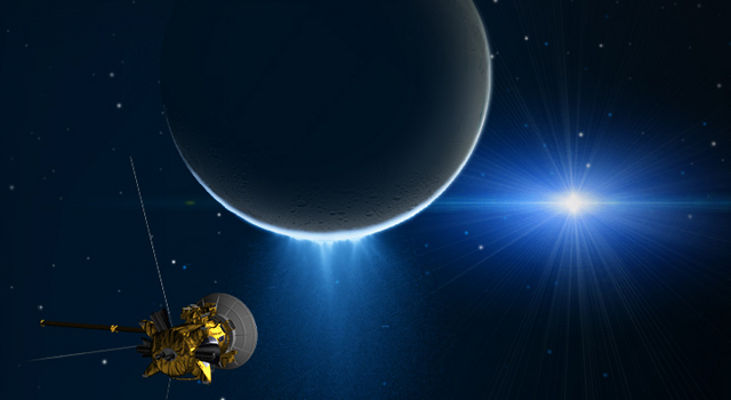
NASA's Cassini spacecraft successfully completed its 26-hour gravity observation at Saturn's moon Enceladus this week, sending back data scientists will use to understand the moon's interior composition and structure.

The flyby took Cassini through the water-rich plume flaring out from Enceladus' south polar region, with a closest approach of about 100 kilometers (60 miles) occurring in the late afternoon of April 27, 2010, Pacific Time, or just after midnight April 28 UTC.

A steady radio link to NASA's Deep Space Network on Earth enabled Cassini's scientists to use the radio science instrument to measure the variations in the gravitational pull of Enceladus. Analyzing the wiggles will help scientists understand whether an ocean, pond or great lake lies under the famous "tiger stripe" fractures that spew water vapor and organic particles from the south polar region.

Results from the experiment will also tell scientists if bubbles of warmer ice in the interior rise toward that region's surface like an underground lava lamp.

Radio science was prime during the flyby and controlled spacecraft pointing. The optical instruments were not pointed at Enceladus during most of the flyby, so the imaging camera obtained some more distant pictures.

Cassini often relies on thrusters to control attitude during flybys such as this one, but this time it turned the thrusters off and relied on its reaction wheels. Using thrusters adds acceleration effects to the spacecraft, complicating the precise measurements needed for the radio science experiment.


Tuesday, April 27, 2010

Cassini to Carry Out Enceladus Flyby


Since July 2004, the NASA Cassini spacecraft has been conducting remarkable scientific observations around the gas giant Saturn. In addition to looking at the planet and its intricate ring system, the probe has also carried out numerous flybys of its many moons, providing astronomers with a wealth of data about many of them, and their interactions with the ring system and Saturn's magnetosphere. An additional flyby from this series will take place today/tomorrow, as Cassini will swing by the peculiar moon Enceladus.

According to mission managers, based at the NASA Jet Propulsion Laboratory, in Pasadena, California, the spacecraft will fly low above the surface of the moon, in order to conduct an intricate and sensitive gravity experiment. During the mission, planetary scientists hope to be able to extract a wealth of data as to the internal composition of Enceladus, which is undoubtedly one of the most interesting bodies in our solar system. The scheduled flight path will take the space probe about 100 kilometers (60 miles) above the surface, at the point of closest approach. This will take place on April 27 Pacific time and April 28 UTC.

One of the things that makes Enceladus stand out from the crowd of Saturnine moons is the fact that astronomers believe it may house a liquid ocean. Naturally, liquid water cannot endure in the frigid temperatures of its surface, but the experts say that it may be buried several kilometers, under a thick ice crust. But the real interest is the south polar region, which featured cracks known as tiger stripes. Through these landscape features, Enceladus emits plumes of water and ice vapors, which apparently play an important role in fueling one of Saturn's rings with material.

The new flyby will take Cassini straight through the plume emissions. During the flight, the instruments aboard the spacecraft will remain silent. In fact, the only thing experts need in order to conduct this experiment is a steady link between the probe and the NASA Deep Space Network on Earth. “Detecting any wiggle will help scientists understand what is under the famous "tiger stripe" fractures that spew water vapor and organic particles from the south polar region. Is it an ocean, a pond or a great salt lake? The experiment will also help scientists find out if the sub-surface south polar region resembles a lava lamp. Scientists have hypothesized that a bubble of warmer ice periodically moves up to the crust and repaves it, explaining the quirky heat behavior and intriguing surface features,” the JPL team says in a statement.


Tuesday, April 20, 2010

Cassini ISS images - April 12-16, 2010


The following new images taken by the Imaging Science Subsystem (ISS) on the Cassini spacecraft are now available:
  • Before Hazy Titan (Released 12 April 2010)
    Saturn's moon Dione passes in front of the larger moon Titan, as seen from the Cassini spacecraft.
  • Lost Among Stars (Released 13 April 2010)
    Saturn's tiny moon Atlas appears almost indistinguishable from the background stars seen in this Cassini spacecraft image.
  • Up and Down Tethys (Released 14 April 2010)
    The Cassini spacecraft profiles several features oriented north-south on Saturn's moon Tethys.
  • In the Arc (Released 15 April 2010)
    This Cassini spacecraft image holds an unseen treasure orbiting within the bright arc of Saturn's G ring: the tiny moonlet Aegaeon.
  • Map of Dione - February 2010 (Released 15 April 2010)
    This global map of Saturn's moon Dione was created using images taken during flybys by NASA's Cassini spacecraft.
  • Dione Polar Maps - February 2010 (Released 15 April 2010)
    The northern hemisphere of Saturn's moon Dione is seen in this polar stereographic maps, mosaicked from the best-available clear-filter images from NASA's Cassini and Voyager missions.
  • Dione Polar Maps - February 2010 (Released 15 April 2010)
    The southern hemisphere of Saturn's moon Dione is seen in this polar stereographic maps, mosaicked from the best-available clear-filter images from NASA's Cassini and Voyager missions.
  • Brilliant Blip Beyond Saturn (Released 16 April 2010)
    The highly reflective moon Enceladus appears as a bright dot beyond a crescent Saturn in this Cassini image.

Saturday, April 17, 2010

Cassini Images First Extraterrestrial Lightnings


Image comment: This image from NASA's Cassini spacecraft -- the first of its kind -- shows lightning on Saturn's night side flashing in a cloud that is illuminated by light from Saturn's rings
Image credits: NASA / JPL-Caltech / Space Science Institute / University of Iowa


The NASA Cassini spacecraft can add another world first to its already-impressive tally of accomplishment. Scientists at the Pasadena, California-based NASA Jet Propulsion Laboratory (JPL) announce that the orbiter is the first probe ever to image lightning strikes on another planet. The explorations robot has been orbiting the gas giant Saturn since July 1, 2004, and it has already sent back exquisite and outstanding images of the planet, its moons and its intricate ring system.

With the newly-received data, investigators at NASA were able to piece together the first short video clip of lightning discharges on another planet. In addition to the video components, the film is also completed by the crackle of radio waves, which Cassini's sensitive instruments detected when the electrical discharges took place.

“This is the first time we have the visible lightning flash together with the radio data. Now that the radio and visible light data line up, we know for sure we are seeing powerful lightning storms,” says Space Research Institute radio and plasma wave science team associate member, Georg Fischer. The facility is located in the city of Graz, Austria.

“What's interesting is that the storms are as powerful – or even more powerful – at Saturn as on Earth. But they occur much less frequently, with usually only one happening on the planet at any given time, though it can last for months,” adds Cassini imaging science subsystem team member Andrew Ingersoll. The expert is based at the California Institute of Technology (Caltech), which houses and manages the JPL.

“The visible-light images tell us a lot about the lightning. Now we can begin to measure how powerful these storms are, where they form in the cloud layer and how the optical intensity relates to the total energy of the thunderstorms,” concludes Caltech expert Ulyana Dyudina, who was the first person to see the lightnings on Saturn. He is also an associate of the Cassini imaging team. Details of the discovery have already been accepted for publication in an upcoming issue of the esteemed scientific journal Geophysical Research Letters.

The Cassini-Huygens mission was a cooperative project of NASA, the European Space Agency (ESA) and the Italian Space Agency (ASI). The JPL manages the Cassini-Huygens mission for NASA Science Mission Directorate, at the agency's Headquarters in Washington DC. The Cassini orbiter and its two onboard cameras were designed, developed and assembled at JPL. The Huygens mission landed successfully on Titan in January, 2005, and began relaying data from the surface. Though never designed to serve as a lander, the instrument continued to send signals for about 90 minutes after impact.

Monday, April 12, 2010

Cassini Finishes Saturnian Doubleheader


This image was taken on April 7, 2010 by NASA's Cassini spacecraft. The camera was pointing at Saturn. But, by appropriate orientation of the spacecraft, the cameras were able to capture Dione in the sights. Image Credit: NASA/JPL/Space Science Institute

NASA's Cassini spacecraft completed its double flyby this week, swinging by Saturn's moons Titan and Dione with no maneuver in between. The spacecraft has beamed back stunning raw images of fractured terrain and craters big and small on Dione, a moon that had only been visited once before by Cassini.

The Titan flyby took place April 5, and the Dione flyby took place April 7 in the UTC time zone, and April 6 Pacific time. During the Titan flyby, an unexpected autonomous reset occurred and Cassini obtained fewer images of Titan than expected. But the cameras were reset before reaching Dione, which was the primary target on this double flyby.

Scientists are poring over data from Dione to discern whether the moon could be a source of charged particles to the environment around Saturn and material to one of its rings. They are also trying to understand the history of dark material found on Dione.

A fortuitous alignment of these moons allowed Cassini to attempt this doubleheader. Cassini had made three previous double flybys and another two are planned in the years ahead. The mission is nearing the end of its first extension, known as the Equinox Mission. It will begin its second mission extension, known as the Solstice Mission, in October 2010.

The Cassini-Huygens mission is a cooperative project of NASA, the European Space Agency and the Italian Space Agency. The Jet Propulsion Laboratory, a division of the California Institute of Technology in Pasadena, manages the Cassini-Huygens mission for NASA's Science Mission Directorate in Washington. The Cassini orbiter was designed, developed and assembled at JPL.

More information about the Titan flyby, dubbed "T67," is available at: http://saturn.jpl.nasa.gov/mission/flybys/titan20100405/.

More information about the Dione flyby, dubbed "D2," is available at: http://saturn.jpl.nasa.gov/mission/flybys/dione20100407/.


Life on Titan


Methane-ethane lakes on Titan. (c) 2008 Karl Kofoed

Research by astrobiologist William Bains suggests that if life has evolved on the frozen surface of Saturn's moon, Titan, it would be strange, smelly and explosive compared to life on Earth. Dr Bains will present his work at the National Astronomy Meeting in Glasgow on Tuesday 13th April.

'Hollywood would have problems with these aliens' says Dr Bains. 'Beam one onto the Starship Enterprise and it would boil and then burst into flames, and the fumes would kill everyone in range. Even a tiny whiff of its breath would smell unbelievably horrible. But I think it is all the more interesting for that reason. Wouldn't it be sad if the most alien things we found in the galaxy were just like us, but blue and with tails?'

Dr Bains, whose research is carried out through Rufus Scientific in Cambridge, UK, and MIT in the USA, is seeking to work out just how extreme the chemistry of life can be. Life on Titan, Saturn's largest moon, represents one of the more bizarre scenarios being studied. Titan is twice as large as our Moon and has a thick atmosphere of frozen, orange smog. At ten times our distance from the Sun, it is a frigid place, with a surface temperature of -180 degrees Celsius. Water is permanently frozen into ice and the only liquid available is liquid methane and ethane, which the Cassini/Huygens mission has shown is present in ponds and lakes on the surface of the moon.

'Life needs a liquid; even the driest desert plant on Earth needs water for its metabolism to work. So, if life were to exist on Titan, it must have blood based on liquid methane, not water. That means its whole chemistry is radically different. The molecules must be made of a wider variety of elements than we use, but put together in smaller molecules. It would also be much more chemically reactive,' said Dr Bains.

The solubility of chemicals in liquid methane is very limited, and strongly dependent on molecular weight. With a few exceptions, molecules with more than 6 heavy (non-hydrogen) atoms are essentially insoluble. So a metabolism running in liquid methane will have to be built of smaller molecules than terrestrial biochemistry, which is typically built of modules of around 10 heavy atoms. However you can only build around 3400 molecules from such a small number of atoms if you are limited to the chemistry that terrestrial life uses i.e. carbon, nitrogen, oxygen, and sulphur and phosphorus in very limited chemical contexts.

Dr Bains explained, 'Terrestrial life uses about 700 molecules, but to find the right 700 there is reason to suppose that you need to be able to make 10 million or more. The issue is not how many molecules you can make, but whether you can make the collection you need to assemble a metabolism. It is like trying to find bits of wood in a lumber-yard to make a table. In theory you only need 5. But you may have a lumber-yard full of offcuts and still not find exactly the right five that fit together. So you need the potential to make many more molecules than you actually need. Thus the 6-atom chemicals on Titan would have to include much more diverse bond types and probably more diverse elements, including sulphur and phosphorus in much more diverse and (to us) unstable forms, and other elements such as silicon.'

Energy is another factor that would affect the type of life that could evolve on Titan. With Sunlight a tenth of a percent as intense on Titan's surface as on the surface of Earth, energy is likely to be in short supply.

'Rapid movement or growth needs a lot of energy, so slow-growing, lichen-like organisms are possible in theory, but velociraptors are pretty much ruled out,' said Bains.

Source: Royal Astronomical Society

Saturday, April 10, 2010

Cassini ISS images - April 5-9, 2010


The following new images taken by the Imaging Science Subsystem (ISS) on the Cassini spacecraft are now available:
  • Yin Yang Iapetus (Released 5 April 2010)
    The two-toned surface of Saturn's moon Iapetus is demonstrated in the dark region of the moon visible on the top left and the bright crater in the lower right of this Cassini portrait.
  • Bright Spokes, Dark Shadow (Released 6 April 2010)
    Bright spokes and the shadow of a moon grace Saturn's B ring in this Cassini spacecraft image.
  • Lit Through the Haze (Released 7 April 2010)
    The Cassini spacecraft looks toward the dark side of Titan as a circle of light is produced by sunlight scattering through the periphery of the atmosphere of Saturn's largest moon.
  • Prometheus Between Rings (Released 8 April 2010)
    Saturn's A ring appears bright compared to the thin F ring, which is shepherded by the moon Prometheus, in this view from the Cassini spacecraft.
  • Profiling Dione's Wisps (Released 9 April 2010)
    Wispy terrain winds across the trailing hemisphere of Saturn's moon Dione in this Cassini view taken during the spacecraft's Jan. 27, 2010 non-targeted flyby.

Friday, April 9, 2010

Saturn's Strange Hexagon Recreated in the Lab


Cosmic geometry. A six-sided shape appears during a lab experiment to simulate Saturn’s north polar atmosphere. Scientists think the results can help explain the appearance of a gigantic hexagon on the planet (lower right).
Credit: Anna Barbosa Agular; (inset) NASA/JPL/University of Arizona


A giant hexagon circling Saturn's north pole has puzzled scientists for decades. Now researchers have managed to recreate the pattern in the lab using little more than water and a spinning table, Science Now reports.

The Saturn hexagon seems to represent the strange rigid path of a jet stream, with each of the six sides being one Earth diameter in length. NASA's Voyager spacecraft first spotted it in the early 1980s, and the Cassini spacecraft has followed up with more visible-light and infrared images.

Physicists at the University of Oxford set out to recreate the Saturn pattern by placing a 30-liter cylinder of water -- almost 8 gallons -- on a slowly spinning table. They also placed a small ring inside the water tank that whirled more rapidly than the cylinder and created a miniature lab version of the jet stream.

Green dye helped the team see how the jet stream changed over time. It turned out that the rate of ring rotation changed the shape of the pattern from a circle to just about anything, including ovals, triangles, squares and various polygons. A bigger difference between the planet and jet stream led to fewer-sided polygons.

The experiment suggests that Saturn's north polar jet stream spins at a certain rate compared to the rest of the planet's atmosphere which favors the hexagon pattern. Similar phenomena have shown up in the centers of hurricanes.

A full report appears in this month's issue of the journal Icarus. But anyone craving a time-lapse spinning image of the Saturn hexagon can look here at some of Cassini's latest handiwork.

Source:- [via Science Now]

Wednesday, April 7, 2010

Looking for life beyond Earth


This photo of Saturn was taken during an eclipse of the sun, explained Carolyn Porco, the director of flight operations and imaging team leader for the Cassini spacecraft in orbit around Saturn.

Scientist Carolyn Porco explored the deeper regions of the solar system and her work with the Cassini mission to Saturn during a talk at Radcliffe.

Could life exist beyond our own blue planet? According to scientist Carolyn Porco, it’s certainly possible.

Porco is the director of flight operations and imaging team leader for the Cassini spacecraft in orbit around Saturn. Her work involves taking detailed pictures in space, shots that offer insights into the nature of the universe, and signs of life elsewhere in the solar system.

“Gorgeous” was how she described the Cassini images to a crowd at the Radcliffe Gymnasium in a talk on April 1. Her listeners agreed.

There was a collective gasp from the student-filled audience as she showed a photo of Saturn taken during an eclipse of the sun. The negative-looking image revealed a sharp outline of the planet and its surrounding rings.

Porco spoke as part of the Radcliffe Institute for Advanced Study Dean’s Lecture Series. The lectures are part of the institute’s Academic Engagement Programs (AEP), which sponsor projects with Harvard faculty, Radcliffe Institute fellows, and Harvard students in scholarly and research endeavors.

The Cassini mission, which began in 1997, has been studying Saturn and its diverse system of moons, sending back stunning images and even evidence that life could exist 932 million miles from Earth.

Some of the mission’s highlights involve analysis of Saturn’s rings, their makeup, the gaps between them, and little “moonlettes.” The study of such moonlettes and the gaps they influence provides a “giant touchstone” for understanding how planets are formed, noted the scientist, who also discussed two of the planet’s moons in detail, Titan and its much smaller counterpart, Enceladus.

With Titan having an atmosphere vaguely similar to the Earth’s, including the presence of molecular nitrogen, as well as a troposphere and stratosphere, researchers were eager to get a closer look at the large moon in orbit around Saturn. They did, with the help of Huygens, a European-designed probe that landed on Titan’s surface in 2005. The event was worthy of a ticker tape parade, said an emotional Porco, who recalled seeing grown men brought to tears when the probe landed.

“This was like a Jules Verne adventure come true,” said Porco. “It was the day humanity landed a device of our making in the outer solar system.”

The images sent back from the probe were “outrageously easy to interpret,” said Porco, and included shots of a branching “dendritic drainage pattern” on the moon’s surface, one that only could have been formed by the flow of liquids. There also were photos of mountainous regions and a series of dunes.

The data revealed that Titan “was alien and exotic and yet strangely Earth-like” in its geological and geographical complexity.

On the small, icy moon Enceladus, “the mother lode of all discoveries was discovered at the South Pole,” said Porco. She described Cassini’s findings of elevated temperatures in the moon’s polar region, as well as an enormous plume of icy particles shooting tens of thousands of kilometers into space.

Analysis of the icy trail, which includes water vapor and trace amounts of organic materials such as methane, carbon dioxide, and propane, suggests it is fueled by geysers erupting from a pocket of salt water within the moon.

The findings, noted Porco, point to the possibility of “an environment where life itself might be stirring.”

“Should we ever discover that a second genesis had occurred in our solar system, independently outside the Earth,” she added, “then I think at that point the spell is broken. The existence theorem has been proven, and we could safely infer from it that life was not a bug but a feature of the universe in which we live, that it’s commonplace and has occurred a staggering number of times.”

Tuesday, April 6, 2010

Cassini to Take a Closer Look at Saturn's Rings


Since 1610, when Galileo first spotted the rings around Saturn using a primitive telescope, astronomers have been fascinated with these remarkable features of the gas giant. In the ensuing 400 years, much data has been collected about a wide array of traits governing them, and significant progress has been made. With the addition of the Cassini spacecraft in the planet's orbit, even more data were collected. However, two of the most important questions about the rings have yet to be answered, Space reports.

What researchers are really interested in knowing is how much the rings weigh, and how old they really are. Thus far, data pertaining to these queries has only been determined hypothetically. Some of the other crucial features about the rings, such as what they are made of, and what forces act on them, influencing their behavior, have already been identified. Still, these two important questions have been left unanswered, Space indicates. Now, new investigations from the Cassini spacecraft are about to cast some light on these mysteries, experts announce.

In charge of the new studies will be interdisciplinary scientist for rings and dust Jeff Cuzzi, who handles this portion of Cassini's mission. The expert, who holds an appointment at the Moffett Field, California-based NASA Ames Research Center, says that the rings around Saturn could not possibly have developed when the solar system first formed, some 4.6 billion years ago, as originally thought. Cuzzi adds that new data would seem to indicate the rings are only one tenth of the age of the solar system, which means they are only hundreds of millions of years old.

The Voyager spacecraft showed for the first time that the rings might not be as old as the Sun, highlighting the fact that processes going on inside them were evolving very fast. But Cassini demonstrated that this speed was in fact even faster. It's now the probe's job to take advantage of the upcoming alignments of the Saturnine system to ensure it collects sufficient data to allow investigators to create a clearer picture of what is going on inside the rings.

Sunday, April 4, 2010

NASA Cassini Significant Events 03/24/10 - 03/30/10


The most recent spacecraft telemetry was acquired on March 30 from the Deep Space Network tracking complex at Madrid, Spain. The Cassini spacecraft is in an excellent state of health and all subsystems are operating normally. Information on the present position and speed of the Cassini spacecraft may be found on the "Present Position" page at: http://saturn.jpl.nasa.gov/mission/presentposition/.

Wednesday, March 24 (DOY 083)

A member of the Cassini Outreach staff was an invited speaker at the 8th annual All-Manitoba First Nation Science Fair Mar. 24th and 25th. First Nations communities are found throughout Manitoba and are home to the aboriginal people of the province. Over 400 students, their families and teachers from 28 schools attended and received Cassini handouts.

In preparation for the solid state recorder on Cassini to be repartitioned for Extended Extended Mission operations, Visual and Infrared Mapping Spectrometer (VIMS) test files have been generated and verified through Instrument Operations Multi-mission Image Processing Laboratory, Mission Sequence Software and Spacecraft Operations Office ground software tools.

Thursday, March 25 (DOY 084)

This week Radio Science performed Ka-TWTA maintenance and the Magnetometer performed calibration rolls. The Cassini Plasma Spectrometer obtained survey measurements, and the Magnetospheric and Plasma Science Instrument teams took measurements for the magnetospheric boundaries, solar wind, and auroral campaigns. Imaging Science (ISS), the Composite Infrared Spectrometer (CIRS) and Ultraviolet Imaging Spectrograph (UVIS) performed another observation in the Titan monitoring campaign, and all the Optical Remote Sensing instruments participated in Titan cloud monitoring campaign observations. UVIS conducted mosaic scans of Saturn's magnetosphere and performed a stellar calibration. CIRS observed Saturn, measuring oxygen compounds of H2O, and CO2 in the stratosphere as a function of latitude. ISS performed observations in support of the Satellite Orbit Campaign, observed the transit of Rhea across Janus, Janus across Titan, and Rhea across Epimetheus, and turned to image the still nearly edge-on, post-equinox E-Ring.

Friday, March 26 (DOY 085)

Orbit Trim Maneuver (OTM) #240 was performed today. This was the apoapsis maneuver setting up for the Titan T67 and Dione D2 encounters on April 5 and 7. The main engine burn began at 8:29 AM PDT. Telemetry immediately after the maneuver showed a burn duration of 17.53 seconds, giving a delta-V of 3.00 m/s. All subsystems reported nominal performance after the maneuver.

Saturday, March 27 (DOY 086)

Sequence leads began uplinking the Instrument Expanded Block files needed to support the S59 sequence. Eight files went up today. A second set of files will go up on Monday, and the background sequence will follow on Apr. 1.

Monday, March 29 (DOY 088)

A news release entitled "1980s Video Icon Glows on Saturn Moon" discusses the highest-resolution-yet temperature map and images of Saturn's icy moon Mimas obtained by NASA's Cassini spacecraft. The data reveal surprising patterns on the surface of the small moon, including unexpected hot regions that resemble 'Pac-Man' eating a dot, and striking bands of light and dark in crater walls. View the release at http://saturn.jpl.nasa.gov/news/newsreleases/newsrelease20100329/.

Port 3 Spacecraft Activity Sequence Files were due today as part of the Science Operations Plan process for S61. The files will be merged and released for review tomorrow.

A Go/No Go meeting was held today for a Live Inertial Vector Propagator update to occur on Apr. 5 for the Titan T67 encounter. It's a "Go" so vectors will be modified for one ISS and three CIRS observations.

The S60 Simulation Coordination meeting was held today. After collecting inputs from the teams, it was determined that the only activity to be tested will be the Radio Science DOY 169-170 Saturn occultation Live Movable Block.

Tuesday, March 30 (DOY 089)

Port 2 Spacecraft Activity Sequence Files were due today as part of the Science Operations Plan process for S62. The files will be merged and released for review tomorrow. The Cassini-Huygens Analysis and Results of the Mission (CHARM) teleconference for March was held today. The topic: "Titan: Ingredients for Life." A PDF of the presentation package may be obtained at http://saturn.jpl.nasa.gov/video/products/MultimediaProductsCharm/. An audio recording of this presentation will be linked to the same location within a few days.

Friday, April 2, 2010

Cassini ISS images - March 29-April 2, 2010


The following new images taken by the Imaging Science Subsystem (ISS) on the Cassini spacecraft are now available:
  • Hiding Rhea (Released 29 March 2010)
    The moon Rhea moves behind Saturn's largest moon, Titan, in this "mutual event" imaged by the Cassini spacecraft.
  • Dual Illuminated Enceladus (Released 30 March 2010)
    Two light sources illuminate Saturn's highly reflective moon Enceladus in this image featuring bright rings and the small moon Pandora in the foreground.
  • Pan's Effects (Released 31 March 2010)
    Saturn's moon Pan, orbiting in the Encke Gap near the top of the image, casts a short shadow on the A ring in this image taken about six months after the planet's August 2009 equinox.
  • Cruising Past Janus (Released 1 April 2010)
    Saturn's moon Epimetheus passes in front of Janus in this "mutual event" chronicled by the Cassini spacecraft.
  • High-Phase Drama (Released 2 April 2010)
    Although the sun is on the other side of Saturn in this dramatic image, some sunlight scatters through the uppermost part of the atmosphere to reach the Cassini spacecraft's cameras.

Tuesday, March 30, 2010

Color Near Herschel Crater


The natural color of Mimas visible to the human eye may be a uniform gray or yellow color, but this mosaic has been contrast-enhanced and shows differences at other wavelengths of light. Image Credit: NASA/JPL/Space Science Institute


Subtle color differences on Saturn's moon Mimas are apparent in this false-color view of Herschel Crater captured by NASA's Cassini spacecraft during its closest-ever flyby of that moon.
The image shows terrain-dependent color variations, particularly the contrast between the bluish materials in and around Herschel Crater (130 kilometers, or 80 miles, wide) and the greenish cast on older, more heavily cratered terrain elsewhere.

The origin of the color differences is not yet understood, but may be caused by subtle differences in the surface composition between the two terrains. False color images from Cassini's previous closest encounter, in 2005, also showed such variations (see PIA06257).

Herschel Crater covers most of the bottom of this image. To create this false-color view, ultraviolet, green and infrared images were combined into a single picture that exaggerates the color differences of terrain on the moon.

These data were combined with a high-resolution image taken in visible light to provide the high-resolution information from the clear-filter image and the color information from the ultraviolet, green and infrared filter images.

The natural color of Mimas visible to the human eye may be a uniform gray or yellow color, but this mosaic has been contrast-enhanced and shows differences at other wavelengths of light.

During its closest-ever flyby on Feb. 13, 2010, Cassini came within about 9,500 kilometers (5,900 miles) of Mimas. This view looks toward the northern part of the hemisphere of Mimas that leads in the moon's orbit around Saturn. Mimas is 396 kilometers (246 miles) across. North on Mimas is up and rotated 12 degrees to the left.

The images were obtained with Cassini's narrow-angle camera on that day at a distance of approximately 16,000 kilometers (10,000 miles) from Mimas. The images were re-projected into an orthographic map projection. A black and white image, taken in visible light with the wide-angle camera, is used to fill in parts of the mosaic. Image scale is 90 meters (195 feet) per pixel.

The Cassini-Huygens mission is a cooperative project of NASA, the European Space Agency and the Italian Space Agency. The Jet Propulsion Laboratory, a division of the California Institute of Technology in Pasadena, manages the mission for NASA's Science Mission Directorate in Washington.

The Cassini orbiter and its two onboard cameras were designed, developed and assembled at JPL. The imaging team is based at the Space Science Institute, Boulder, Colo.

A Cosmic Pac-Man: Saturn's Moon Mimas


Image comment: A cosmic Pac-Man. Temperature map of Saturn's moon Mimas
Image credits: NASA / JPL / GSFC / SWRI / SSI

In a recent flyby it conducted around the Saturnine moon Mimas, the NASA Cassini spacecraft managed to obtain the most detailed, high-resolution images of the space rock ever produced. The recent photos of the surface, combined with complex temperature maps, provide the most comprehensive view to date of the peculiar natural satellite. Researchers investigating the photos were surprised to find an old “friend” on the moon, the famous video game character Pac-Man. It appears to be eating one of its famous dot, in the temperature map that Cassini produced.

Some of the most interesting data collected by the spacecraft, in orbit around Saturn since July 2004, also reveal striking bands of light and dark in some crater walls, a finding that astronomers and planetary scientists say merits more analysis. “Other moons usually grab the spotlight, but it turns out Mimas is more bizarre than we thought it was. It has certainly given us some new puzzles,” says Cassini project scientist Linda Pilker, who is based at the NASA Jet Propulsion Laboratory, in Pasadena, California. The lab manages the Cassini mission.

The Pac-Man resemblance is only the latest in a row. The entire space rock looks like the Death Star of Star Wars fame, due to the enormous Herschel Crater that adorns its surface. The new temperature maps were collected using the composite infrared spectrometer aboard the space orbiter. The instrument is very precise, but the readings were also easy to collect due to the proximity of the flight. Cassini flew around Mimas on February 13, the JPL team says. The Pac-Man-like shape seen in the image has a temperature of about 92 Kelvin (minus 294 degrees Fahrenheit), whereas the cooler regions feature an average temperature of only 77 Kelvin (minus 320 degrees Fahrenheit). The “dot” the cosmic Pac-Man is eating is about 84 Kelvin (minus 310 degrees Fahrenheit).

“We suspect the temperatures are revealing differences in texture on the surface. It's maybe something like the difference between old, dense snow and freshly fallen powder,” says Cassini composite infrared spectrometer team member John Spencer. He holds an appointment at the Boulder, Colorado-based Southwest Research Institute (SwRI). What the science team operating the spacecraft is currently trying to figure out is why the sharp

Wednesday, March 24, 2010

How Enceladus Interacts with Saturn's E Ring


Image comment: Cassini image of Enceladus and the E ring around Saturn
Image credits: NASA / JPL / Space Science Institute


When the NASA/ESA spacecraft Cassini first discovered that the Saturnine moon Enceladus was spewing out plumes of ice and water vapors from cracks at its south pole, they were amazed. This was a one-of-a-kind observation, and it changed the way astronomers looked at the gas giant's rings. Cassini revealed that some of the plumes reached far enough into space to merge with the planet's E ring, and add to it. New investigations with the space probe have recently yielded new insight into the interactions that develop between the moon and the ring, as well as on the cycle these particles take.

For the research, German investigators from the Max Planck Institutes for Nuclear Physics looked at data collected by a dust collector instrument aboard the spacecraft, and compared these readings with model data obtained through computer simulations. The team discovered that, although the ice plumes from the moon are added to the E ring, Enceladus reclaims most of its particles within the time frame of a few orbits, as it moves around its parent planet. The new investigation was only made possible by the fact that Cassini was recently driven nose-first through the E ring, during which time it collected samples in its detectors.

In addition to the samples, the probe was also capable of investigating the structure of the ring, as well as its vertical extent. Such studies are very difficult to conduct, because Saturn's rings, although extending from thousands of miles in width, are incredibly narrow, often not exceeding 3 meters. The recent dust analyzer measurements were taken as a reference point in new computer simulations, which provided astronomers with new data on how the E ring is supplied with material, the contribution that Enceladus makes to its growth, and the rates at which the two exchange matter. Details of the work appear in the latest issue of the respected scientific journal Icarus, PhysOrg reports.

The new work was conducted by MPI expert Sascha Kempf. The scientist explains that most icy particles fall back on Enceladus within two orbits, but adds that the ones which make it out of the moon's sphere of influence may endure for 50 to 400 years in the E ring, before eventually falling back to where they came from. During the nose-first “dives” in the ring, Cassini managed to identify a peculiar fact – matter appeared to be distributed randomly, rather than in the ordered fashion experts expected. More thorough study revealed that each spike was the impression left behind by one of Enceladus' ice and water plumes.

Friday, March 19, 2010

Cassini ISS images - March 15-19, 2010


The following new images taken by the Imaging Science Subsystem (ISS) on the Cassini spacecraft are now available:
  • Young and Old (Released 15 March 2010)
    Both ancient and more recent surfaces are exposed in this view of Saturn's moon Enceladus.
  • Shadow and Ringshine (Released 16 March 2010)
    Saturn casts its shadow on the rings in this Cassini image that also shows how the rings reflect sunlight onto the dark side of the planet.
  • Zooming in on Adiri (Released 17 March 2010)
    The Cassini spacecraft takes a look through the atmosphere of Saturn's largest moon to spy light and dark in the area called Adiri on Titan.
  • Widening Rings (Released 18 March 2010)
    Saturn's rings and its moon Rhea are imaged before a crescent of the planet.
  • Cratered Spud (Released 19 March 2010)
    Appearing like eyes on a potato, craters cover the dimly lit surface of the moon Prometheus in this high-resolution image from the Cassini spacecraft's early 2010 flyby.

An Overview of Cassini's Accomplishments


Researchers managing the NASA/ESA Cassini mission to Saturn have published two new scientific papers, showing the progress that has been achieved in the nearly 6 years since the orbiter has been observing the gas giant. The amount of data that this particular spacecraft is without equal in terms of quantity and quality, the experts say, and its observations have helped shape our understanding of how Saturn's rings, atmosphere, surface, interior and moons work, Space reports.
The gas giant's rings are without doubt its most interesting feature. They are the most intricate structures in the solar system, and they also appear to be changing as they are being watched. Experts say that, since Cassini arrived at Saturn, in June 2004, our knowledge of the rings has increased exponentially. The features revealed new moons, as well as a large number of dynamic forces that continuously act to determine their shape. Overall, thanks to data from the orbiter, the rings moved from being plain structures to being represented in 3D. This allowed experts to infer even more about their structure, how they appeared, and what are the forces sustaining them.

While they do extend for tens of thousands of kilometers in space, the rings are oftentimes as little as 3 meters in thickness. This means that when Saturn is at equinox – sunlight falling perpendicularly to the Equator – the rings are invisible to us. The telescopes we have today are still too imprecise to allow us to resolve such thin structures. But Cassini, orbiting Saturn closer than any other spacecraft, is uniquely equipped to survey the formations in these conditions. The last equinox took place last year, and the orbiter was in position to snap photos. The next such event will take place in about 15 years.

Cassini also managed to gather impressive amounts of data on two of the most interesting moons in the solar system, Enceladus and Titan. Each of them captured the interest of astronomers for different reasons. Enceladus appears to be spewing out jets of water and ice from cracks at its South Pole, which means that its interior may be housing an ocean of liquid water, suitable for the development of early life. Conversely, Titan features lakes of liquid hydrocarbons on its surface, which will most likely constitute the target for future space exploration missions.

Monday, March 15, 2010

Saturn's Rings and the History of the Solar System


New studies appear to demonstrate that the intricate patterns carved up in the rings of the gas giant Saturn are somehow connected to the history of the solar system. More than 400 years after Galileo first discovered the enormous planet, researchers are starting to get new insight into how the two are related. This is only possible due to the contributions that telescopes such as Hubble and spacecraft such as the NASA/ESA Cassini space probe have brought to science, the BBC News reports.

The rings system surrounding Saturn is the best developed in the entire solar system, and they are made out of billions upon billions of very small ice particles, which agglomerate in very peculiar patterns. They create rings that are up to 70,000 kilometers wide, but which at some points are only 3 meters (roughly 10 feet) thick. This was extremely interesting for astronomers when they first looked closely at the structures. At equinox, when sunlight falls directly on the Saturnine equator, the rings become invisible, as they are seen edge-on from Earth. At this point, we have no telescope capable of making out a 3-meter-thick structure all the way to the middle of the solar system.

One of the best possible spots on our planet to identify with the famous rings is a glacial lagoon in Iceland, which was used as a shooting site for the BBC2's Wonders of the Solar System – Order Out of Chaos show. Brian Cox, the host of the TV show, said that the location left a deep impression on him. “I climbed up a floating iceberg in the lagoon and was left there alone whilst we did a series of sweeping helicopter shots. It was a magical and quiet place (until the helicopter flew past) and I allowed my mind to drift. The rings are magnificently pure water-ice, just like the icebergs, and I genuinely felt transported three-quarters of a billion miles away to the rings of Saturn,” he said.

But the similarities between the two locations are more than just aesthetically pleasing. Scientists plan to use data they collect from the lagoon as a starting point for understanding how the massive planetary rings relate to the earliest days of the solar system. It was first born into chaos, but then all the planets aligned themselves into an ordered manner, and the precise same pattern is seen in the rings. “In the rings, we're learning something about our own origins. Because the physical processes that go on in the rings are probably similar to what went on in the early Solar System and we've got this incredible opportunity to observe those processes happening in front of our eyes,” says Queen Mary, University of London-based Cassini scientist, Carly Murray.

Friday, March 12, 2010

Cassini Data Show Ice and Rock Mixture Inside Titan


This artist's illustration shows the likely interior structure of  Saturn's moon Titan deduced from gravity field data collected by NASA's  Cassini spacecraft.

This artist's illustration shows the likely interior structure of Saturn's moon Titan deduced from gravity field data collected by NASA's Cassini spacecraft. Image credit: NASA/JPL

PASADENA, Calif. -- By precisely tracking NASA's Cassini spacecraft on its low swoops over Saturn's moon Titan, scientists have determined the distribution of materials in the moon's interior. The subtle gravitational tugs they measured suggest the interior has been too cold and sluggish to split completely into separate layers of ice and rock.

The finding, to be published in the March 12 issue of the journal Science, shows how Titan evolved in a different fashion from inner planets such as Earth, or icy moons such as Jupiter's Ganymede, whose interiors have split into distinctive layers.

"These results are fundamental to understanding the history of moons of the outer solar system," said Cassini Project Scientist Bob Pappalardo, commenting on his colleagues' research. Pappalardo is with NASA's Jet Propulsion Laboratory in Pasadena, Calif. "We can now better understand Titan's place among the range of icy satellites in our solar system."

Scientists have known that Titan, Saturn's largest moon, is about half ice and half rock, but they needed the gravity data to figure out how the materials were distributed. It turns out Titan's interior is a sorbet of ice studded with rocks that probably never heated up beyond a relatively lukewarm temperature. Only in the outermost 500 kilometers (300 miles) is Titan's ice devoid of any rock, while ice and rock are mixed to various extents at greater depth.

"To avoid separating the ice and the rock, you must avoid heating the ice too much," said David J. Stevenson, one of the paper's co-authors and a professor of planetary science at the California Institute of Technology in Pasadena. "This means that Titan was built rather slowly for a moon, in perhaps around a million years or so, back soon after the formation of the solar system."

This incomplete separation of ice and rock makes Titan less like Jupiter's moon Ganymede, where ice and rock have fully separated, and perhaps more like another Jovian moon, Callisto, which is believed to have a mixed ice and rock interior. Though the moons are all about the same size, they clearly have diverse histories.

The Cassini measurements help construct a gravity map, which may help explain why Titan has a stunted topography, since interior ice must be warm enough to flow slowly in response to the weight of heavy geologic structures, such as mountains.

Creating the gravity map required tracking minute changes in Cassini's speed along a line of sight from Earth to the spacecraft as it flew four close flybys of Titan between February 2006 and July 2008. The spacecraft took paths between about 1,300 to 1,900 kilometers (800 to 1,200 miles) above Titan.

"The ripples of Titan's gravity gently push and pull Cassini along its orbit as it passes by the moon and all these changes were accurately recorded by the ground antennas of the Deep Space Network within 5 thousandths of a millimeter per second [0.2 thousandths of an inch per second] even as the spacecraft was over a billion kilometers [more than 600 million miles] away," said Luciano Iess, a Cassini radio science team member at Sapienza University of Rome in Italy, and the paper's lead author. "It was a tricky experiment."

The results don't speak to whether Titan has an ocean beneath the surface, but scientists say this hypothesis is very plausible and they intend to keep investigating. Detecting tides induced by Saturn, a goal of the radio science team, would provide the clearest evidence for such a hidden water layer.

A Cassini interdisciplinary investigator, Jonathan Lunine, said of his colleagues' findings, "Additional flybys may tell us whether the crust is thick or thin today." Lunine is with the University of Rome, Tor Vergata, Italy, and the University of Arizona, Tucson. "With that information we may have a better understanding of how methane, the ephemeral working fluid of Titan's rivers, lakes and clouds, has been resupplied over geologic time. Like the history of water on Earth, this is fundamental to a deep picture of the nature of Titan through time."

The Cassini-Huygens mission is a cooperative project of NASA, the European Space Agency and the Italian Space Agency. JPL, a division of Caltech, manages the project for NASA's Science Mission Directorate in Washington. The Cassini orbiter was designed, developed and assembled at JPL. Cassini's radio science subsystem has been jointly developed by NASA and the Italian Space Agency (ASI).

More Cassini information is available, at http://www.nasa.gov/cassini and http://saturn.jpl.nasa.gov .