Showing posts with label Herschel and Planck. Show all posts

Wednesday, March 17, 2010

Planck sees tapestry of cold dust


The image spans about 50° of the sky. It is a three-colour combination constructed from Planck’s two highest frequency channels (557 and 857 GHz, corresponding to wavelengths of 540 and 350 micrometres), and an image at the shorter wavelength of 100 micrometres made by the IRAS satellite. This combination visualises dust temperature very effectively: red corresponds to temperatures as cold as 10° above absolute zero, and white to those of a few tens of degrees. Overall, the image shows local dust structures within 500 light-years of the Sun.

Credits: ESA and the HFI Consortium, IRAS

Giant filaments of cold dust stretching through our Galaxy are revealed in a new image from ESA’s Planck satellite. Analysing these structures could help to determine the forces that shape our Galaxy and trigger star formation.

Planck is principally designed to study the biggest mysteries of cosmology. How did the Universe form? How did the galaxies form? This new image extends the range of its investigations into the cold dust structures of our own Galaxy.
Planck scanning the sky
The image shows the filamentary structure of dust in the solar neighbourhood – within about 500 light-years of the Sun. The local filaments are connected to the Milky Way, which is the pink horizontal feature near the bottom of the image. Here, the emission is coming from much further away, across the disc of our Galaxy.

The image has been colour coded to discern different temperatures of dust. White-pink tones show dust of a few tens of degrees above absolute zero, whereas the deeper colours are dust at around –261°C, only about 12 degrees above absolute zero. The warmer dust is concentrated into the plane of the Galaxy whereas the dust suspended above and below is cooler.

Planck's newly imaged region shown in box
“What makes these structures have these particular shapes is not well understood,” says Jan Tauber, ESA Project Scientist for Planck. The denser parts are called molecular clouds while the more diffuse parts are ‘cirrus’. They consist of both dust and gas, although the gas does not show up directly in this image.

There are many forces at work in the Galaxy to help shape the molecular clouds and cirrus into these filamentary patterns. For example, on large scales the Galaxy rotates, creating spiral patterns of stars, dust, and gas. Gravity exerts an important influence, pulling on the dust and gas. Radiation and particle jets from stars push the dust and gas around, and magnetic fields also play a role, although to what extent is presently unclear.

Bright spots in the image are dense clumps of matter where star formation may take place. As the clumps shrink, they become denser and better at shielding their interiors from light and other radiation. This allows them to cool more easily and collapse faster.

Filamentary structures on large and small scales in the Milky Way

ESA’s Herschel space telescope can be used to study such regions in detail, but only Planck can find them all over the sky. Launched together in May 2009, Planck and Herschel are both studying the coolest components of the Universe. Planck looks at large structures, while Herschel can make detailed observations of smaller structures, such as nearby star-forming regions.

One puzzle to be solved is why there is similar filamentary structure on both the large and the small scale. “That’s a big question,” says Tauber.

The new image is a combination of data taken with Planck’s High Frequency Instrument (HFI), at wavelengths of 540 micrometres and 350 micrometres, and a 100-micrometre image taken in 1983 with the IRAS satellite.

The HFI data were recorded as part of Planck’s first all-sky survey at microwave wavelengths. As the spacecraft rotates, its instruments sweep across the sky. During every rotation, they cross the Milky Way twice. Thus, in the course of Planck’s mission to precisely map the afterglow of the big bang, it is also producing exquisite maps of the Galaxy.

Tuesday, May 19, 2009

Herschel Phones Home


ESA's 35-metre deep-space ground station at New Norcia, Australia. Credit: ESA

ESA's 35-metre deep-space ground station at New Norcia, Australia. Credit: ESA


For the first time in spaceflight history, a satellite has used mobile phone technology to radio back to Earth. The Herschel spacecraft – which launched on May 14, called home two days later using the same technology used in GSM mobile phone networks to send test data to ESA’s deep space tracking station. “Herschel’s 1.5-Mbps test transmission - roughly the same data rate provided by a home broadband Internet connection - was picked up at ESA’s ESTRACK station at New Norcia, Australia, on Saturday, as the satellite was travelling some 280 000 km from Earth,” said John Dodsworth, the Herschel-Planck Flight Operations Director.

This marks the first-ever use of Gaussian Minimum Shift Keying (GMSK) modulation in space. GMSK is commonly used in Global System for mobile Communication (GSM) mobile phone networks due to its very efficient use of bandwidth and power.
Plot showing Herschel's mobile phone call received at New Norcia station

Plot showing Herschel's mobile phone call received at New Norcia station


In a typical GSM mobile phone network, the same technology transmits data at a somewhat lower speed. The Planck spacecraft that was launched along with Herschel also uses GMSK technology, and its transmission capability will be tested later during the satellite’s commissioning phase.

During their missions, the GMSK-based radio links will be used by both spacecraft to transfer data gathered by their scientific instruments and on-board subsystems, providing information on flight status and overall health.

The development was driven by the need to use bandwidth more efficiently in view of the growing number of ESA missions that require X-band communications via the Agency’s deep space ground stations.

The GSM standard is the most popular modulation standard for mobile phone networks in the world. According to the GSM Association, terrestrial GSM networks now cover more than 80% of the world’s population in more than 212 countries and territories - and will soon extend 1.5 million kms further to L2, Herschel and Plank’s final orbital destination.

Source: ESA

Saturday, May 16, 2009

Herschel and Planck slide across the sky


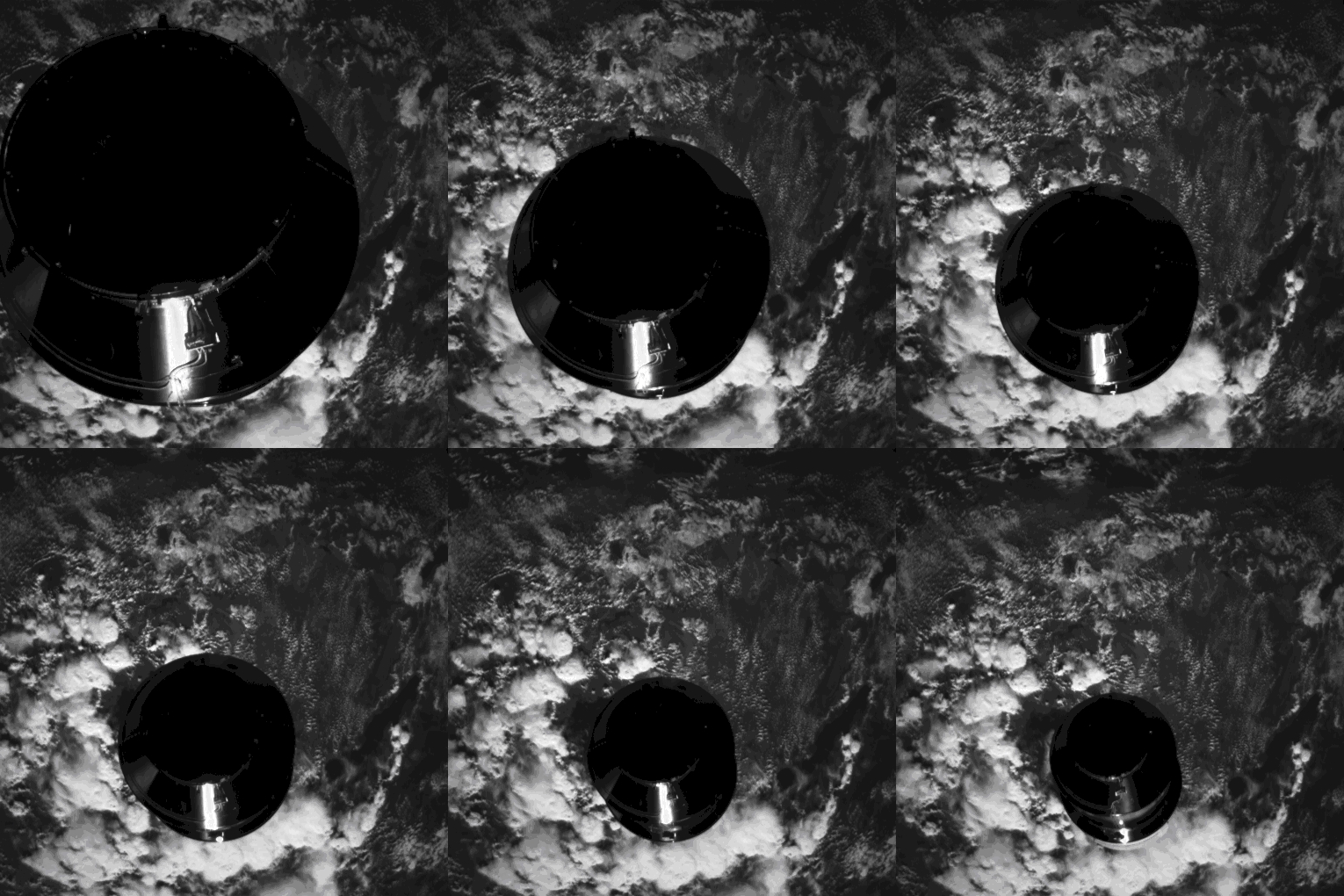
Yesterday, the European Space Agency successfully launched the space observatories Herschel and Planck. Today, they released two cool videos of the event: one was taken by the spacecraft itself and shows the Planck payload moving away from Herschel.

The other video was taken by a one-meter tracking ’scope in the Canary Islands, and shows the two spacecraft together with the Sylda launch vehicle gliding across the sky minutes after the two observatories separated from the vehicle:


Whoa, that’s cool. The two bright objects are Herschel and Planck, and the dimmer one is the Sylda

Thursday, May 14, 2009

Herschel and Planck Launch Succesfully


Ariane V launch.  Credit: Arianespace tv

Ariane V launch. Credit: Arianespace tv


The Herschel and Planck spacecraft successfully launched together Thursday from Europe’s Spaceport in Kourou, French Guiana. The Ariane V rocket performed flawlessly, with the rocket’s trajectory matching exactly the predicted flight path. The two spacecraft separated individually and in different directions from the launch vehicle, about four minutes apart, after spinning to orient themselves correctly for their high elliptical orbits. Just 40 minutes after lift-off, Herschel and Planck sent their first radio signals to Earth, confirming that they both are operating in good shape. In a few months, they will arrive at the L-2 (Lagrange) point in space, 1.5 million kilometers (930,000 miles) from Earth, beyond the Moon’s orbit. By early next year, they’ll begin operations to open new windows on the Universe. Herschel will be studying star formation while Planck will be looking back at the Big Bang.

Herschel will be looking at specific points in space while Planck will look at the whole sky.
Herschel in 3-D. Credit:  Nathanial Burton-Bradford.

Herschel in 3-D. Credit: Nathanial Burton-Bradford.


This 3-D image of Herschel was created by Nathanial Burton-Bradford. Check out other images at his Flickr page.

Named after the 18th century astronomer who discovered infrared light, the Herschel spacecraft is 7 meters in length and 4 meters wide. The telescope mirror is 3.5 meters wide, 4 times bigger than previous space telescope, and will collect long-wavelength radiation from some of the coldest and most distant objects in the Universe. The mirror is also a technological wonder: it uses 12 silicon carbide petals fused together into a single piece. Herschel will be the only space observatory to cover a spectral range from the far infrared to sub-millimeter.

To detect cold, dark objects, Herschel has to be even colder. 2,400 liters of liquid helium cools the spacecraft to -273 Celsius. Like a thermal camera can see a person’s body heat, Herschel will look beyond dust and gas to see inside star forming regions, study comets and look into the distant universe where galaxies collide and give birth to stars. Scientists are planning for at least three years of operation from Herschel.

Planck.  Credit: ESA

Planck. Credit: ESA


Planck will be sweeping the whole sky continuously to map out a picture of the Universe as it was 13.7 million years ago. The spacecraft is four by four meters, with a 1.5 meter primary mirror that is surrounded with a baffle to limit any stray light from nearby objects, the Sun, Earth and Moon. Planck’s detectors have to be cold as well, and will be chilled to between 273 C to just 1/10th of degree above Absolute Zero.
Routine observations with Planck are expected to last for at least 15 months. The mission could be extended depending on the status of helium 3 isotope that is being used to chill the spacecraft.
Planck will test key questions in cosmology, investigating the cosmic microwave background, to ascertain the primordial constituents of the universe, and look for existence of gravitational waves. Planck will journey back in time, while giving us a better understanding of the future.

Herschel and Planck Launch Succesfully


Ariane V launch.  Credit: Arianespace tv

Ariane V launch. Credit: Arianespace tv


The Herschel and Planck spacecraft successfully launched together Thursday from Europe’s Spaceport in Kourou, French Guiana. The Ariane V rocket performed flawlessly, with the rocket’s trajectory matching exactly the predicted flight path. The two spacecraft separated individually and in different directions from the launch vehicle, about four minutes apart, after spinning to orient themselves correctly for their high elliptical orbits. Just 40 minutes after lift-off, Herschel and Planck sent their first radio signals to Earth, confirming that they both are operating in good shape. In a few months, they will arrive at the L-2 (Lagrange) point in space, 1.5 million kilometers (930,000 miles) from Earth, beyond the Moon’s orbit. By early next year, they’ll begin operations to open new windows on the Universe. Herschel will be studying star formation while Planck will be looking back at the Big Bang.

Herschel will be looking at specific points in space while Planck will look at the whole sky.
Herschel in 3-D. Credit:  Nathanial Burton-Bradford.

Herschel in 3-D. Credit: Nathanial Burton-Bradford.


This 3-D image of Herschel was created by Nathanial Burton-Bradford. Check out other images at his Flickr page.

Named after the 18th century astronomer who discovered infrared light, the Herschel spacecraft is 7 meters in length and 4 meters wide. The telescope mirror is 3.5 meters wide, 4 times bigger than previous space telescope, and will collect long-wavelength radiation from some of the coldest and most distant objects in the Universe. The mirror is also a technological wonder: it uses 12 silicon carbide petals fused together into a single piece. Herschel will be the only space observatory to cover a spectral range from the far infrared to sub-millimeter.

To detect cold, dark objects, Herschel has to be even colder. 2,400 liters of liquid helium cools the spacecraft to -273 Celsius. Like a thermal camera can see a person’s body heat, Herschel will look beyond dust and gas to see inside star forming regions, study comets and look into the distant universe where galaxies collide and give birth to stars. Scientists are planning for at least three years of operation from Herschel.

Planck.  Credit: ESA

Planck. Credit: ESA


Planck will be sweeping the whole sky continuously to map out a picture of the Universe as it was 13.7 million years ago. The spacecraft is four by four meters, with a 1.5 meter primary mirror that is surrounded with a baffle to limit any stray light from nearby objects, the Sun, Earth and Moon. Planck’s detectors have to be cold as well, and will be chilled to between 273 C to just 1/10th of degree above Absolute Zero.
Routine observations with Planck are expected to last for at least 15 months. The mission could be extended depending on the status of helium 3 isotope that is being used to chill the spacecraft.
Planck will test key questions in cosmology, investigating the cosmic microwave background, to ascertain the primordial constituents of the universe, and look for existence of gravitational waves. Planck will journey back in time, while giving us a better understanding of the future.

Watch Herschel/Planck Launch Live


Ariane V with the Herschel and Planck spacecraft ready to launch. Credit: ESA-CNES-Arianespace / Optique Vidéo du CSG

Ariane V with the Herschel and Planck spacecraft ready to launch. Credit: ESA-CNES-Arianespace / Optique Vidéo du CSG


The launch of the Herschel and Planck spacecraft is scheduled for 13:12 GMT (9:12 EDT) this morning (Thursday). You can watch it live, starting at 12:40 GMT (8:40 EDT) at this link.

The two spacecraft are launching together in what was originally a cost saving move, but the complexity of preparing two spacecraft at once has caused frequent delays and cost overruns. However, now that launch day is here, hopefully the cutting-edge technologies included in both spacecraft will soon pay off in new discoveries astronomy and cosmology. Read more about the two spacecraft here.

Also, Robert Simpson at Orbiting Frog has some interactive features that show the altitude, velocity and acceleration of the Ariane rocket as it progress through the air into space. You can even click and drag to zoom in on a section of these charts, and move your mouse around inside them to get more information.

And the first of five spacewalks for the Hubble Space Telescope servicing mission starts at around 9:00 am EDT, and will be pretty much an all-day event. Watch live on NASA TV.