Showing posts with label Sun. Show all posts

Monday, August 9, 2010

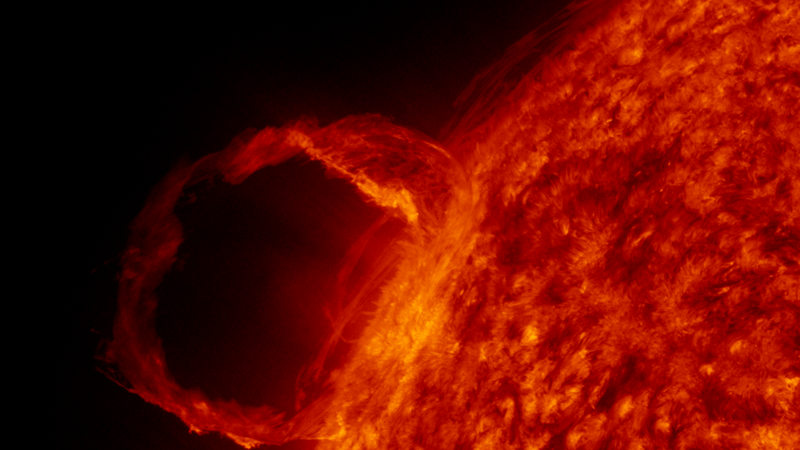
STEREO Detect Impossibly Fast Solar Eruption


The twin components of the NASA Solar TErrestrial RElations Observatory (STEREO) mission were recently able to detect one of the fastest and largest solar eruptions in recent history. On August 1, the Sun released a massive amount of matter and radiation, which sped away from the star at a whooping 2.2 million miles per hour. Despite this massive speed, the two spacecrafts were able to detect the event, and send their conclusions back to Earth, where researchers confirmed the discovery.

The large solar flare triggered a massive eruption called a coronal mass ejection (CME). This is one of the most dangerous things that can go on in the star, experts say. CME produce massive amounts of highly-energetic particles, which have the effect of a heavy bombardment on Earth's protective layer, the magnetosphere. The entire force of the ejection was unleashed on our planet on Tuesday, August 3, and the main result was a heavy intensification of the northern lights, the Aurora Borealis. We got off easy this time, solar physicists say, as larger CME can have devastating effects on our infrastructure.

Representatives of the American space agency said in a recent statement that “these kinds of eruptions are one of the first signs that the Sun is waking up and heading toward another solar maximum expected in the 2013 time frame.” The star functions in 11-year-old cycles, each of which contains a solar maximum and a minimum. These periods are named according to the amount of solar activity (sunspots, solar flares, CME) that takes place on the Sun's surface. Over the past two years, the star should have exited the minimum stage, and begin resuming its activity. But the minimum persisted, and it's only now that the Sun is beginning to show signs of recovery.

STEREO is in a unique position to conduct very accurate observations of the solar surface, given that its twin spacecrafts allow for it to look at the Sun in 3D. This allows solar physicists to get a depth-of-view in their studies, that is impossible with any other telescope. Not even the Solar Dynamic Observatory (SDO), the most advanced Sun-watching instrument, can produce 3D views of its targets. STEREO is capable of doing this because its components fly apart from each other, providing independent views of the same event from two vantage points, Space reports.

Wednesday, April 28, 2010

SDO Observes Massive Eruption And Scorching Rain


Just last week, scientists working with NASA's new Solar Dynamics Observatory (SDO) released the most astonishing movies of the sun anyone had ever seen. Now, they're doing it again.

"SDO has just observed a massive eruption on the sun-one of the biggest in years," says Lika Guhathakurta of NASA headquarters in Washington DC. "The footage is not only dramatic, but also could solve a longstanding mystery of solar physics."

Karel Schrijver of Lockheed Martin's Solar and Astrophysics Lab is leading the analysis. "We can see a billion tons of magnetized plasma blasting into space while debris from the explosion falls back onto the sun surface. These may be our best data yet."

The movie, recorded on April 19th, spans four hours of actual time and more than 100,000 km of linear space. "It's huge," says Schrijver. Indeed, the entire planet Earth could fit between the plasma streamers with room to spare.

Astronomers have seen eruptions like this before, but rarely so large and never in such fluid detail. As science team member Alan Title of Lockheed Martin pointed out at last week's press conference, "no other telescope comes close to the combined spatial, temporal and spectral resolution of SDO."

Schrijver says his favorite part of the movie is the coronal rain. "Blobs of plasma are falling back to the surface of the sun, making bright splashes where they hit," he explains. "This is a phenomenon I've been studying for years."

Coronal rain has long been a mystery. It's not surprising that plasma should fall back to the sun. After all, the sun's gravity is powerful. The puzzle of coronal rain is how slowly it seems to fall. "The sun's gravity should be pulling the material down much faster than it actually moves. What's slowing the descent?" he wonders.

For the first time, SDO provides an answer.

"The rain appears to be buoyed by a 'cushion' of hot gas," says Schrijver. "Previous observatories couldn't see it, but it is there."

One of SDO's game-changing capabilities is temperature sensing. Using an array of ultraviolet telescopes called the Atmospheric Imaging Assembly (AIA), the observatory can remotely measure the temperature of gas in the sun's atmosphere. Coronal rain turns out to be relatively cool-"only" 60,000 K. When the rains falls, it is supported, in part, by an underlying cushion of much hotter material, between 1,000,000 and 2,200,000 K.

"You can see the hot gas in the color-coded temperature movie," says Schrijver. "Cool material is red, hotter material is blue-green. The hot gas effectively slows the descent of the coronal rain."

Dick Fisher, the head of NASA's Heliophysics Division in Washington DC, has been working in solar physics for nearly forty years. "In all that time," he says, "I've never seen images like this."

"I wonder, what will next week bring?"


First Serious Study Looks for the Sun's 'Brothers'


Like all other stars before it, and all those that will come after it, the Sun was born in a nebula, surrounded by thick, massive clouds of cosmic dust and hydrogen gas. It first ignited some 5 billion years ago, alongside tens to thousands of other stars, all of which must be of similar age and chemical makeup. Now, in the first-ever complex study on the issue, astronomers begin looking for the Sun's siblings, in a research that could ultimately provide us with more clues as to how the solar system evolved over time, Technology Review reports.

Finding the birthplace of our star could also assist astronomers in answering fundamental questions about the origin of the solar system, in addition to providing information as to which direction the Sun has been traveling in for the past 5 billion years, when reported to the center of the Milky Way. This knowledge could then better inform us in understanding the conditions that eventually led to the appearance of life on Earth billions of years ago. Mysteries related to sudden changes in the planet's climate could also be revealed by studying stars formed from the same nebula as the Sun.

When compared with other yellow dwarfs, as well as with other objects in this part of the Milky Way, the Sun exhibits an unusually-high concentration of metallic elements. This abnormality has puzzled astronomers for many years, and it's now believed that identifying the star's birthplace could help unravel this enigma as well. For all these reasons, researchers at the Missouri State University, led by expert Anthony Brown, conducted the first serious astronomical search for the stars that appeared at the same time our own celestial fireball did. Unfortunately, the results are not encouraging.

The main issue plaguing such an effort is the magnitude of the needed search. Recent data on how nebulae function reveal that some stars may be ejected from within their nurseries as if sprayed from a cosmic hose. This means that their formation process is very chaotic, and also implies that our star's siblings may be spread apart over distances exceeding 3,000 light-years. Covering such vast distances is like looking for a needle in a haystack, given that the area contains an estimated 100 million stars. Of these objects, astronomers have accurate information on just 100,000 of them, which is a small portion of our solar system's neighborhood.

There is no reason to disappoint, however. Though a Sun sibling has not been found within 100 parsecs from our star, astronomers take comfort in the fact that the year 2012 will see the launch of the Gaia spacecraft. The instrument will be the successor of the Hipparcos space probe, which is responsible for providing experts with most data on the 100,000 stars analyzed until now. Gaia will conduct the first decent-quality 3D investigation of the Milky Way, and will map more than 1 billion stars. However, we will have to wait until 2020 for this census to be done.

Wednesday, April 21, 2010

Nasa's Solar Dynamics Observatory returns first images


The first public release of images from the satellite record huge explosions and great looping prominences of gas.

The observatory's super-fine resolution is expected to help scientists get a better understanding of what drives solar activity.

Launched in February on an Atlas rocket from Cape Canaveral, SDO is expected to operate for at least five years.

Researchers hope in this time to go a long way towards their eventual goal of being able to forecast the effects of the Sun's behaviour on Earth.

Solar activity has a profound influence on our planet. Huge eruptions of charged particles and the emission of intense radiation can disrupt satellite, communication and power systems, and pose a serious health risk to astronauts.

Scientists working on SDO say they are thrilled with the quality of the data received so far.

"When we see these fantastic images, even hard-core solar physicists like myself are struck with awe, literally," said Lika Guhathakurta, the SDO programme scientist at Nasa Headquarters.

SDO is equipped with three instruments to investigate the physics at work inside, on the surface and in the atmosphere of the Sun.

The probe views the entire solar disc with a resolution 10 times better than the average high-definition television camera. This allows it to pick out features on the surface and in the atmosphere that are as small as 350km across.

The pictures are also acquired at a rapid rate, every few seconds.

In addition, the different wavelengths in which the instruments operate mean scientists can study the Sun's atmosphere layer by layer.

A key quest will be to probe the inner workings of the solar dynamo, the deep network of plasma currents that generates the Sun's tangled and sometimes explosive magnetic field.

It is the dynamo that ultimately lies behind all forms of solar activity, from the solar flares that explode in the Sun's atmosphere to the relatively cool patches, or sunspots, that pock the solar disc and wander across its surface for days or even weeks.

"The SDO images are stunning and the level of detail they reveal will undoubtedly lead to a new branch of research into how the fine-scale solar magnetic fields form and evolve, leading to a much, much better understanding of how solar activity develops," said co-investigator Richard Harrison from the UK's Rutherford Appleton Laboratory (RAL).

"It's like looking at the details of our star through a microscope," he told BBC News.

And Dr Guhathakurta added: "It's thought that [SDO] is going to revolutionise heliophysics much as the Hubble Space Telescope has revolutionised astrophysics and cosmology, which is true. There is however a very key difference. While Hubble is designed to observe almost everything in the cosmos, SDO is designed to study only one thing and that is our very own star. It is tailor-made for the study of Sun star."

SDO's three remote-sensing instruments are:

Helioseismic and Magnetic Imager (HMI) : will study the motions and magnetic fields at the Sun's surface, or photosphere, to determine what is happening inside the star. It will try to decipher the physics of the solar dynamo - the very source of the Sun's activity. The dynamo regulates all forms of solar activity from the lightning-fast eruptions of solar flares to the slow decadal undulations of the sunspot cycle.

Atmospheric Imaging Assembly (AIA) : is a suite of four telescopes that will image the corona, the outer layer of the Sun's atmosphere. The AIA filters cover 10 different wavelength bands, or colours, from the extreme ultraviolet to the visible. It will see details as small as 725km across. These images will be acquired every 10 seconds. Previous observatories have taken pictures at best every few minutes.

Extreme Ultraviolet Variability Experiment (EVE) : will measure the Sun's energy output in extreme-ultraviolet (E-UV) wavelengths (this is called irradiance) with unprecedented precision. The Sun is at its most variable in the E-UV. E-UV rays can break apart atoms and molecules in the Earth's upper-atmosphere, creating a layer of ions that can severely disturb radio signals.

The UK has a prominent role in the mission through the Rutherford Appleton Laboratory in Didcot; the e2v company in Chelmsford which supplied CCD camera detectors; the Mullard Space Science Laboratory in London; the University of Warwick; the University of Sheffield; and the University of Central Lancashire (UCLan) in Preston.

UCLan handles the SDO data coming into the UK. With the mission producing some 1.5 tera-bytes per day, it requires a dedicated gateway for scientists to exploit.

Source:- SDO

Monday, April 12, 2010

Analyzing the Sun's 'Magnetic Flux Ropes'


Image comment: The three images reveal gases trapped in the flux rope at different temperatures, from 1.5 million degrees Celsius in the image on the left through to 2.5 million degrees Celsius in the right hand image
Image credits: JAXA / ISAS / NASA / STFC

Coronal mass ejections (CME) are some of the most interesting and important phenomena going on on the surface of our Sun. As the years pass, astronomers and astrophysicists gain a deeper and deeper understanding of how these structures form and develop. This is of tremendous importance, as the CME have the potential to create secondary events that can fry power grids and satellites, radiate our planet, and jeopardize the lives of people working aboard the International Space Station (ISS). It would now appear that one of the keys to learning more of CME is analyzing magnetic flux ropes.

As some experts put it, almost nothing happens on the Sun without the presence of very strong magnetic fields. These structures can take on various shapes and sizes, and they can trigger solar tsunamis, sunspots, coronal mass emissions and so on. Given the perilous nature of some of these events, it stands to reason that experts want to learn more about how they form. That is why scientists at the University College London (UCL), in the United Kingdom, used the Hinode satellite to gain more data on how these extremely large magnetic fields form.

Magnetic flux ropes are a type of field that can be readily detected in the interplanetary space as CME approach our planet. This led experts to assume that they play an important role in stimulating the emissions. “Magnetic flux ropes have been observed in interplanetary space for many years now and they are widely invoked in theoretical descriptions of how CME are produced. We now need observations to confirm or reject the existence of flux ropes in the solar atmosphere before an eruption takes place to see whether our theories are correct,” explains UCL expert Dr Lucie Green, the lead researcher on the investigation.

“Flux ropes are thought to play a vital role in the evolution of the magnetic field of the Sun. However, the physics of flux ropes is applied across the Universe. For example, a solar physics model of flux rope ejection was recently used to explain the jets driven by the accretion disks around the supermassive black holes found in the center of galaxies,” the scientist adds. Details of the work conducted at UCL were presented today, April 12, at the RAS National Astronomy Meeting, in Glasgow, Scotland, AlphaGalileo reports.

Thursday, April 8, 2010

Studying Coronal Mass Ejections in More Depth


Image comment: Image extracted from a CME eruption simulation, run at the University of California in Berkeley
Image credits: NRL / UCB

As our Sun is beginning to wake up from its prolonged period of solar minimum, researchers are again starting to take interest in the possible effects that this awakening may have on our planet. Earth itself is at no risk from these outbursts of hot, ionized gas from the star, but everything that operates with electricity is. Understanding the nature of coronal mass ejections (CME), and also that of the other phenomena associated with it, might help scientists devise better methods of taking care of Earth's satellites and power grids.

In addition, astrophysicists may learn more about the intricate phenomena going on inside the Sun, just under its surface. These mechanisms are the ones that promote the formation of these CME, which can have numerous “side-effects.” Some of these associated events include solar flares, eruptive prominences, coronal waves and post-eruptive arcades. Most of these phenomena in turn trigger the release of various forms of radiation, which are then spread throughout the solar system. Naturally, some of them also hit our planet, PhysOrg reports.

Fortunately, Earth is surrounded by a protective shield of sorts, a layer of the atmosphere called the magnetosphere. Its main role is to deflect incoming solar radiation, but the problem is that it does not protect our satellites, and the International Space Station (ISS). Given how much we rely on satellite communications, transmissions, and that six astronauts permanently inhabit the ISS, it stands to reason that losing our orbital capabilities would have far-reaching consequences. This is why predicting space weather has become so important over the past few years.

A new CME study is currently being carried out by a team of physicists at the US Naval Research Laboratory's (NRL) Space Science Division. The group wants to learn more about potential spacecraft anomalies and communication interruptions that events associated with CME might trigger. Establishing the composition of the ejections is one of the most important steps. Physicists say that this knowledge could help us determine how the events occur, and also how they propagate through interplanetary space.


Tuesday, April 6, 2010

Very Cool Brown Dwarf Found Near the Sun


Image comment: Images of UGPSJ0722-05 taken with three different telescopes
Image credits: Philip Lucas / arXiv

An international collaboration of astronomers has recently discovered the closest neighbor the Sun has, that it definitely outside of our solar system. The researchers say this is a Jupiter-sized object, most likely a very cool brown dwarf. It was found to be wandering around some 9 light-years away from the Sun, which is very close by cosmic standards, Technology Review reports.

A brown dwarf is a very special kind of cosmic object. Generally, normal or very large stars are formed when immense clouds of cosmic dust and gas come together to create a very large mass. Eventually, once a certain threshold is reached, the cloud collapses on itself, and ignites in the process, triggering nuclear fusion. When this happens, a new star is born. Still, not all clouds of this type end up producing full-blown stars. Some of them fail to ignite, and the result is a body known as a brown dwarf.

This is the class the Jupiter-sized object found lurking nearby pertains to. Gas giants in our solar system are believed to have the same type of mass, structure and composition as these failed stars. Astronomers agree that if the outer planets in our solar system had formed in the vastness of space, they too would have been classified as brown dwarfs. The newly-found object, discovered by a team led by University of Hertfordshire astronomer Philip Lucas, has been named UGPSJ0722-05.

The brown dwarf is believed to experience the same surface temperature as Jupiter, or about 500 degrees Kelvin (226.85 Celsius). But the really remarkable thing about this body is that spectral analysis of its atmosphere has revealed the fact that it contains traces of the hydrocarbon methane, as well as telltale signs of water vapors. This is bound to make the object of a prime target for future investigations by astrobiologists. Undoubtedly, a heated debate will begin as to what type of molecules lie in UGPSJ0722-05's atmosphere. It is also certain that its name will be changed to something more catchy, and easy to pronounce and remember.

Tuesday, March 30, 2010

The Sun Appears to Be Resuming Its Activity


Starting in December 2009, the Sun appears to have intensified its levels of activity, as evidenced by the growing number of sunspots appearing on its surface. These phenomena are a clear indicator that things are picking up again, after almost two years of nearly-perfect calm. Throughout this time frame, our parent star remained undisturbed for nearly 70 percent of the time, which was very unusual.

Now, new data from the European Space Agency's (ESA) venerable SOHO spacecraft appears to indicate that things are picking up, and that more and more sunspots are beginning to appear on the star's surface. This is nothing but good news for solar physicists, as they were beginning to wonder if the Sun is not going through a “phase” as it remained clear of dark spots. It is estimated among experts that the current solar minimum, from which the star is only now appearing to get out of, was the longest in the last century.

At one point, experts were even concerned that a new Maunder minimum might ensue. “This last minimum was much deeper and longer than anybody predicted. We were beginning to joke that we had entered another Maunder minimum,” says ESA SOHO project scientist Bernhard Fleck. A Maunder minimum is a reference to a time frame that took place between 1645 and 1715 when, according to existing records, it did not appear on the Sun for the most part. This is precisely what went on in 2008 and 2009, and experts were beginning to wonder whether they had another of these events on their hands.

“I think we are heading for something like the early 20th century when everything was much less active. When SOHO was launched almost 15 years ago, understanding the solar cycle was not one of its scientific objectives, now it is one of the key questions,” Fleck adds. He adds that the solar cycle may in fact have been more active in the last couple of decades, which prompted solar physicists to create a false idea about how strong the solar maximums and minimums should have been. It may be that the recently-recorded levels of activity are simply a return to normal, the scientist concludes.

Monday, March 15, 2010

Sun's Conveyor Belt Runs at Incredible Speeds


Image comment: A basic schematic showing the Great Conveyor Belt inside the Sun
Image credits: NASA

In a recent discovery that may explain why the Sun has so few sunspots so close to its solar maximum, experts have demonstrated that the top layers of the gigantic, plasma conveyor belt at work inside the celestial object is moving at record-setting speeds. While researchers are still not yet sure as to what implications this phenomenon has on the solar system, and on the star itself, they say that its existence may account for the decreased level of solar activity we have been experiencing for the past two years or so, Space reports.

“I believe this could explain the unusually deep solar minimum we've been experiencing. The high speed of the conveyor belt challenges existing models of the solar cycle and it has forced us back to the drawing board for new ideas,” NASA solar physicist David Hathaway says of the discovery. The expert is also one of the coauthors of a new scientific study accompanying the findings, which appears in the March 12 issue of the top-rated publication Science. The researchers base their conclusions on highly detailed datasets that were collected by the NASA Solar and Heliospheric Observatory (SOHO).

The movement of plasma on the Sun can be likened to our oceanic conveyor belts back home. They are pathways circulated by currents, which force the body of the oceans (on Earth), and of terribly hot plasma (on the Sun) to circulate over the face of the respective body. In the case of the star, the Great Conveyor Belt is extremely massive, and it takes roughly 40 years to complete a single cycle. It is divided into two distinct branches, North and South, and many investigators believe that these two major currents may be influencing the sunspot activity. However, a clear idea as to how this happens has yet to be devised, they admit.

When the top layers of the Great Conveyor Belt skim the surface of the star, they produce a host of interactions and events, including magnetic elements (knots of solar magnetism). These features are then carried to the poles, and SOHO has instruments sensitive enough to allow for astronomers to peer at the process. “It's a little like measuring the speed of a river on Earth by clocking the leaves and twigs floating downstream,” Hathaway says. University of Memphis student Lisa Rightmire, who worked with the expert last year, was able to determine that the belt moved at a massive speed, of between 20 and 30 miles.

While his may seem slow by human standards, it is incredibly fast for one of the largest things in the solar system. “Sunspots are supposedly rooted to the bottom of the belt. So the motion of sunspots tells us how fast the belt is moving down there.” “While the top of the conveyor belt has been moving at [a] record-high speed, the bottom seems to be moving at [a] record-low speed. Another contradiction,” Hathaway concludes.

Friday, February 12, 2010

NASA Successfully Launches a New Eye on the Sun


CAPE CANAVERAL, Fla. - NASA's Solar Dynamics Observatory, or SDO, lifted off Thursday from Cape Canaveral Air Force Station's Launch Complex 41 on a first-of-a-kind mission to reveal the sun's inner workings in unprecedented detail. The launch aboard an Atlas V rocket occurred at 10:23 a.m. EST.

The most technologically advanced of NASA's heliophysics spacecraft, SDO will take images of the sun every 0.75 seconds and daily send back about 1.5 terabytes of data to Earth -- the equivalent of streaming 380 full-length movies.

"This is going to be sensational," said Richard R. Fisher, director of the Heliophysics Division at NASA Headquarters in Washington. "SDO is going to make a huge step forward in our understanding of the sun and its effects on life and society."

The sun's dynamic processes affect everyone and everything on Earth. SDO will explore activity on the sun that can disable satellites, cause power grid failures, and disrupt GPS communications. SDO also will provide a better understanding of the role the sun plays in Earth's atmospheric chemistry and climate.

SDO is the crown jewel in a fleet of NASA missions to study our sun. The mission is the cornerstone of a NASA science program called Living With A Star. This program will provide new understanding and information concerning the sun and solar system that directly affect Earth, its inhabitants and technology.

The SDO project is managed at NASA's Goddard Space Flight Center in Greenbelt, Md. NASA's Launch Services Program at Kennedy Space Center managed the payload integration and launch.

For launch coverage, briefing materials, and multimedia, visit: http://www.nasa.gov/mission_pages/sdo/news/briefing-materials-20100209.html

For more information about the SDO mission, visit: http://www.nasa.gov/sdo

Saturday, June 20, 2009

Sunspot Delay Due to Sluggish Solar "Jet Stream"?


A diagram of the sun's interior shows the location (at left) of a jet stream-like plasma current called the torsional oscillation.

Data released in June 2009 suggest the particularly slow movement of this jet stream could be to blame for the delay in increased solar activity that has been stumping astronomers. (Image courtesy AAS)

A sluggish, jet stream-like flow deep inside the sun could be to blame for the delay in increased solar activity that has been stumping astronomers.

(Read "Sun Oddly Quiet—Hints at Next 'Little Ice Age'?")

The jet stream, which is actually a plasma current called a torsional oscillation, has been migrating more slowly than usual through the star's interior, according to a team led by Frank Hill of the National Solar Observatory in Tucson, Arizona.

Every 11 years the sun generates new jet streams near its poles. These streams slowly shift from east to west toward the solar equator over a period of 17 years.

When the stream reaches a certain latitude, the sun starts producing new sunspots—relatively cool, dark regions on the sun that mark areas of magnetic disturbance.

But the stream associated with the current cycle of solar activity has been moving even slower than normal, Hill said.

Obvious in Hindsight?

Based on new data from sun-tracking instruments known as the Global Oscillation Network Group (GONG) and the Solar and Heliospheric Observatory (SOHO), Hill and colleagues saw that it took an extra year for the stream to cross a distance of 10 degrees latitude, compared with previous solar cycles.

The new measurements also show that the stream has finally reached the critical latitude linked to sunspot production, which could explain why solar activity finally seems to be picking up.

"It's not clear whether this [slower jet stream] is a cause or a consequence" of the mysterious solar quiet, Hill said. "But the fact that we see it a couple of years in advance [of the sun's extended quiet] makes me think it's a cause."

Jesper Schou, an astrophysicist at Stanford University who works on SOHO, said that, since the stream's sluggish motion had shown up in previous data, in hindsight the solar quiet might have been predicted.

But both GONG and SOHO, right now the best instruments for monitoring the sun's interior, have been in operation for only 14 years. That's a relatively short period for scientists to get comfortable with the type of data being returned. By contrast, sunspots have been tracked as a measure of solar activity for hundreds of years.

"You need some amount of confidence" with the data before recognizing any discrepancies, Schou said. "After a while it's like, Oh, it looks very obvious."

Findings presented this week at a meeting of the American Astronomical Society Solar Physics Division in Boulder, Colorado.

Read the whole article on National Geographic

Friday, June 19, 2009

Mystery Of The Missing Sunspots Solved?


A helioseismic map of the solar interior. Tilted red-yellow bands trace solar jet streams. Black contours denote sunspot activity. When the jet streams reach a critical latitude around 22 degrees, sunspot activity intensifies. (Credit: Image courtesy of National Solar Observatory)

ScienceDaily (June 19, 2009) — The sun is in the pits of a century-class solar minimum, and sunspots have been puzzlingly scarce for more than two years. Now, for the first time, solar physicists might understand why.

At an American Astronomical Society press conference in Boulder, Colorado, researchers announced that a jet stream deep inside the sun is migrating slower than usual through the star's interior, giving rise to the current lack of sunspots.

Rachel Howe and Frank Hill of the National Solar Observatory (NSO) in Tucson, Arizona, used a technique called helioseismology to detect and track the jet stream down to depths of 7,000 km below the surface of the sun. The sun generates new jet streams near its poles every 11 years, they explained. The streams migrate slowly from the poles to the equator and when a jet stream reaches the critical latitude of 22 degrees, new-cycle sunspots begin to appear.

Howe and Hill found that the stream associated with the next solar cycle has moved sluggishly, taking three years to cover a 10 degree range in latitude compared to only two years for the previous solar cycle.

The jet stream is now, finally, reaching the critical latitude, heralding a return of solar activity in the months and years ahead.

"It is exciting to see", says Hill, "that just as this sluggish stream reaches the usual active latitude of 22 degrees, a year late, we finally begin to see new groups of sunspots emerging."

The current solar minimum has been so long and deep, it prompted some scientists to speculate that the sun might enter a long period with no sunspot activity at all, akin to the Maunder Minimum of the 17th century. This new result dispells those concerns. The sun's internal magnetic dynamo is still operating, and the sunspot cycle is not "broken."

Because it flows beneath the surface of the sun, the jet stream is not directly visible. Hill and Howe tracked its hidden motions via helioseismology. Shifting masses inside the sun send pressure waves rippling through the stellar interior. So-called "p modes" (p for pressure) bounce around the interior and cause the sun to ring like an enormous bell. By studying the vibrations of the sun's surface, it is possible to figure out what is happening inside. Similar techniques are used by geologists to map the interior of our planet.

In this case, researchers combined data from GONG and SOHO. GONG, short for "Global Oscillation Network Group," is an NSO-led network of telescopes that measures solar vibrations from various locations around Earth. SOHO, the Solar and Heliospheric Observatory, makes similar measurements from space.

"This is an important discovery," says Dean Pesnell of NASA's Goddard Space Flight Center. "It shows how flows inside the sun are tied to the creation of sunspots and how jet streams can affect the timing of the solar cycle."

There is, however, much more to learn.

"We still don't understand exactly how jet streams trigger sunspot production," says Pesnell. "Nor do we fully understand how the jet streams themselves are generated."

To solve these mysteries, and others, NASA plans to launch the Solar Dynamics Observatory (SDO) later this year. SDO is equipped with sophisticated helioseismology sensors that will allow it to probe the solar interior better than ever before.

"The Helioseismic and Magnetic Imager (HMI) on SDO will improve our understanding of these jet streams and other internal flows by providing full disk images at ever-increasing depths in the sun," says Pesnell.

Continued tracking and study of solar jet streams could help researchers do something unprecedented--accurately predict the unfolding of future solar cycles.

Source: ScienceDaily


Thursday, June 18, 2009

Scientists create first comprehensive computer model of sunspots


The interface between a sunspot's central and outer regions shows a complex structure.

In a breakthrough that will help scientists unlock mysteries of the sun and its impacts on Earth, scientists have created the first-ever comprehensive computer model of sunspots. The resulting visuals capture both scientific detail and remarkable beauty. The results are published this week in a paper in Science Express. The research was supported by the National Science Foundation (NSF). The high-resolution simulations of sunspots open the way for scientists to learn more about the vast mysterious dark patches on the sun's surface, first studied by Galileo. Sunspots are associated with massive ejections of charged plasma that can cause geomagnetic storms and disrupt communications and navigational systems. They are also linked to variations in solar output that can affect weather on Earth and exert a subtle influence on climate patterns.

"Understanding complexities in the solar magnetic field is key to 'space weather' forecasting," says Richard Behnke of NSF's Division of Atmospheric Sciences. "If we can model sunspots, we may be able to predict them and be better prepared for the potential serious consequences here on Earth of these violent storms on the sun."

Scientists at the National Center for Atmospheric Research (NCAR) in Boulder, Colo., collaborated with colleagues at the Max Planck Institute for Solar System Research (MPS) in Germany, building on a computer code that had been created at the University of Chicago.

"This is the first time we have a model of an entire sunspot," says lead paper author Matthias Rempel, a scientist at NCAR's High Altitude Observatory. "If you want to understand all the drivers of Earth's atmospheric system, you have to understand how sunspots emerge and evolve. Our simulations will advance research into the inner workings of the sun as well as connections between solar output and Earth's atmosphere."

Ever since outward flows from the center of sunspots were discovered 100 years ago, scientists have worked to explain the complex structure of sunspots, whose number peaks and wanes during the 11-year solar cycle. Sunspots accompany intense magnetic activity that is associated with solar flares and massive ejections of plasma that can buffet Earth's atmosphere. The resulting damage to power grids, satellites and other sensitive technological systems takes an economic toll on a rising number of industries.

Creating such detailed simulations would not have been possible even as recently as a few years ago, before the latest generation of supercomputers and a growing array of instruments to observe the sun. The new computer models capture pairs of sunspots with opposite polarity. In striking detail, they reveal the dark central region, or umbra, with brighter umbral dots, as well as webs of elongated narrow filaments with flows of mass streaming away from the spots in the outer penumbral regions. They also capture the convective flow and movement of energy that underlie the sunspots, and which are not directly detectable by instruments.

The models suggest that the magnetic fields within sunspots need to be inclined in certain directions in order to create such complex structures. The authors conclude that there is a unified physical explanation for the structure of sunspots in umbra and penumbra that's the consequence of convection in a magnetic field with varying properties.

The simulations can help scientists decipher the mysterious, subsurface forces in the sun that cause sunspots. Such work may lead to an improved understanding of variations in solar output and their impacts on Earth.

To create the simulations, the research team designed a virtual, three- dimensional domain measuring about 31,000 miles by 62,000 miles, and about 3,700 miles in depth--an expanse as long as eight times Earth's diameter, and as deep as Earth's radius.

The scientists then used a series of equations involving fundamental physical laws of energy transfer, fluid dynamics, magnetic induction and feedback, and other phenomena to simulate sunspot dynamics at 1.8 billion grid points within the domain, each spaced about 10 to 20 miles apart.

They solved the equations on NCAR's new bluefire supercomputer, an IBM machine that can perform 76 trillion calculations per second. The work drew on increasingly detailed observations from a network of ground- and space-based instruments to verify that the model captured sunspots realistically. The new models are far more detailed and realistic than previous simulations that failed to capture the complexities of the outer penumbral region.

The researchers noted, however, that even their new model does not accurately capture the lengths of the filaments in parts of the penumbra. They can refine the model by placing the grid points closer together, but that would require more computing power than is currently available.

"Advances in supercomputing power are enabling us to close in on some of the most fundamental processes of the sun," says Michael Knölker, director of NCAR's High Altitude Observatory and a co-author of the paper. "With this breakthrough simulation, an overall comprehensive physical picture is emerging for everything that observers have associated with the appearance, formation, dynamics, and the decay of sunspots on the sun's surface."

Source: National Science Foundation

Friday, June 12, 2009

Solar Activity to Have Lowest High in 90 Years?


After a perplexing quiet spell, the sun appears to be stirring—but astrophysicists remain divided about what our star is going to do next.

The sun was expected to hit a low in 2008 as part of its normal 11-year cycle of activity.

But it stayed quiet until very recently, confounding scientists and sparking speculation of a sun-triggered "little ice age."

Solar physicists have denied that potential, saying that today's greenhouse gases have much more influence on global temperatures than the sun.

Now the sun appears to be waking up, and the latest prediction from a panel convened by NASA and the National Oceanic and Atmospheric Administration says that the sun is simply a year late.

Solar activity will peak in 2013, the experts say, with 90 sunspots predicted that year.

Still, this would be the lowest peak recorded since the 1920s, and the experts are cautious about their own predictions.

"Go ahead and mark your calendar for [a peak in] May 2013," panel member Dean Pesnell of the Goddard Space Flight Center said in a press statement.

"But use a pencil."

Back to Normal?

Sunspots, solar flares, and so-called zonal flows—streams of plasma akin to Earth's jet streams—are all tracked as signs of magnetic activity on the sun.

When the sun is very active, solar storms can disrupt satellites, endanger astronauts, and knock out power grids on Earth.

Recent data show that the sun's activity is slowly ratcheting back up. Most experts, including panel member and solar researcher Leif Svalgaard, are taking this as a sign that the sun is back on track and headed toward a solar maximum.

Svalgaard notes, however, that current predictions are based more on long-term statistics than the sun's recent behavior. A peak of 90 sunspots, he said, may be optimistic.

Meanwhile, other experts are suggesting that this year's low may not be so unusual.

In a paper in the June issue of the Astrophysical Journal, Ilya Usoskin of the Solankyla Geophysical Observatory in Finland suggests that the past 50 years represent a so-called grand maximum in solar activity.

During this period, Usoskin says, the sun's average magnetic activity was unusually high.

Mike Lockwood, a solar terrestrial physicist at the University of Southampton in the U.K., agrees. The sun may now be returning to the quieter times of the 1920s, which were closer to normal, he said.

Astrophysicists over the past few decades didn't recognize the grand maximum, he suggests, because scientists back then had incomplete data.

Sunspots have been tracked since the invention of the telescope, for example. But zonal flows were first studied only 30 years ago, and the sun's radio emissions were first observed in the 1940s.

"If the ground rules have changed underneath you, then the prediction could be completely wrong," he said.

"It is quite possible that the solar activity will be even lower than the panel is estimating," Lockwood said. "I have a suspicion … this will be a yet weaker cycle" than the one before.

NASA panel member Svalgaard argues that ice-core evidence from Greenland "does not indicate unusually high recent solar activity compared to the last 600 years."

And no matter the numbers, he said, the risk remains that any single solar storm could be strong enough to cause billions of dollars in damage to communications systems, including satellites.

"The frequency of storms does depend on the solar cycle," Svalgaard said. "But the strength of an individual storm isn't related."